
By Justin Folks/DWR
Prior to the 2025/2026 deer season, the Board of Directors of the Virginia Department of Wildlife Resources (DWR) approved the most changes to deer hunting regulations during any regulation cycle in recent memory, and perhaps the agency’s history. Most of these changes were made in efforts to increase hunting opportunity and antlerless harvest on private lands west of the Blue Ridge (WBR), while others were implemented to help increase antlerless harvest in some counties east of the Blue Ridge (EBR). All counties WBR received at least a four-week-long firearms season on private lands, with some receiving a seven-week-long season (mostly counties in chronic wasting disease [CWD] Disease Management Areas [DMAs]).
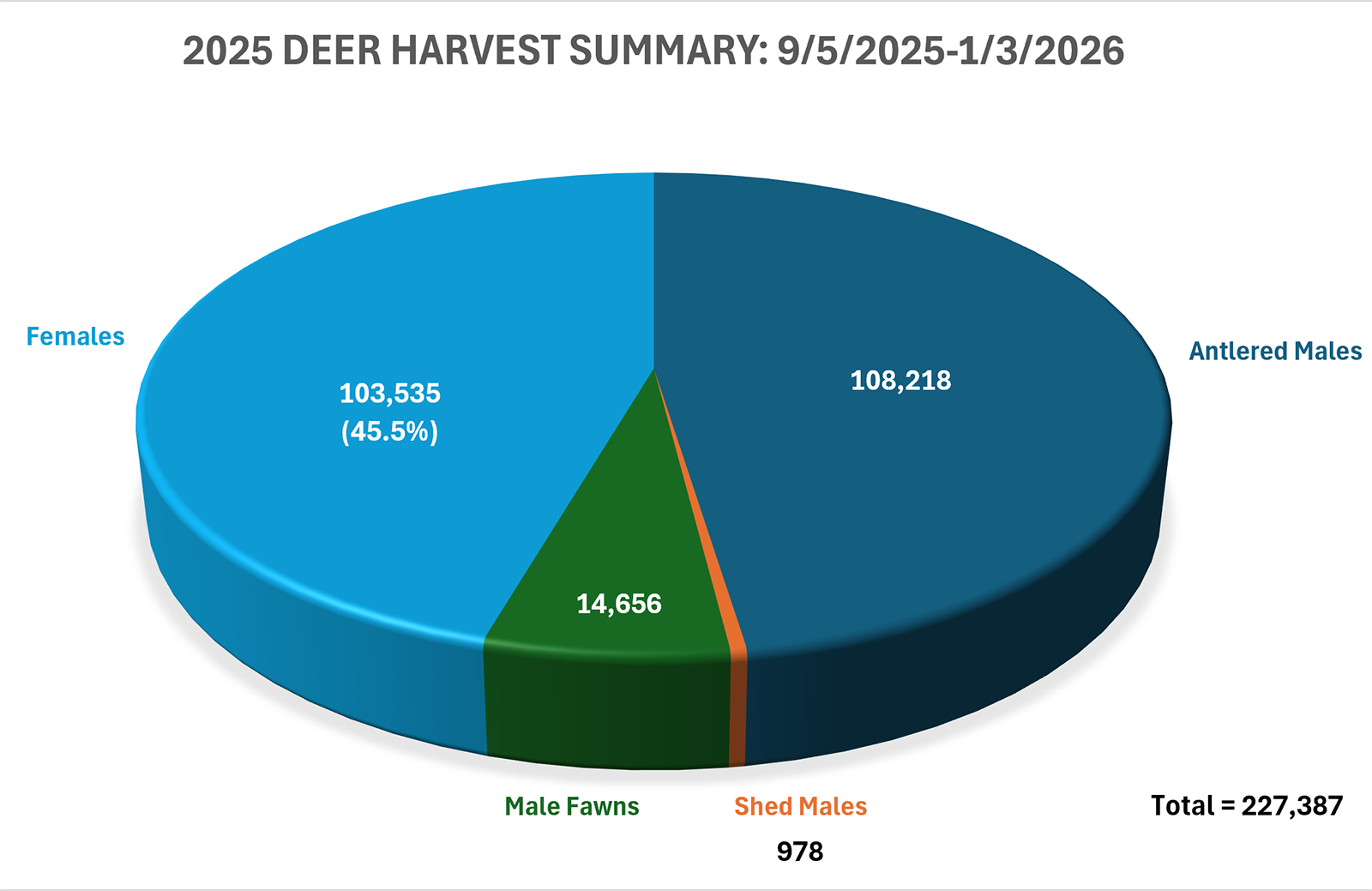
During the past deer season (including the early antlerless seasons), 227,387 deer were reported harvested by hunters in Virginia. This total included 108,218 antlered bucks, 14,656 button bucks, 978 shed bucks, and 103,535 does (45.5% females; Figure 1). Archery (including crossbows) accounted for 14% of the deer kill; muzzleloaders, 23%; and firearms, 63%, which is typical. The late antlerless season added approximately 2,200 antlerless deer to the final total. The 2025/2026 statewide harvest total was 11% greater than the previous season, the female kill increased 14%, and the antlered buck kill only increased about 7%, suggesting our regulation changes did what we wanted them to.
What’s interesting is that last year’s harvest pace was ahead of the 2024/2025 season from the very beginning, so we can’t just point to the new regulations as the sole cause. Whatever the reason, our Virginia hunters had a successful season. Keep up the great work!
Chronic Wasting Disease (CWD) Update
Despite sampling fewer deer than the previous year, we again broke our record for most positives at 126. Sixty (60) of those were in Frederick County alone. Thankfully, none of the positive detections last year will have any implications for creating new DMAs or adding counties to existing DMAs. See Figure 2 for the map of our current CWD DMAs.
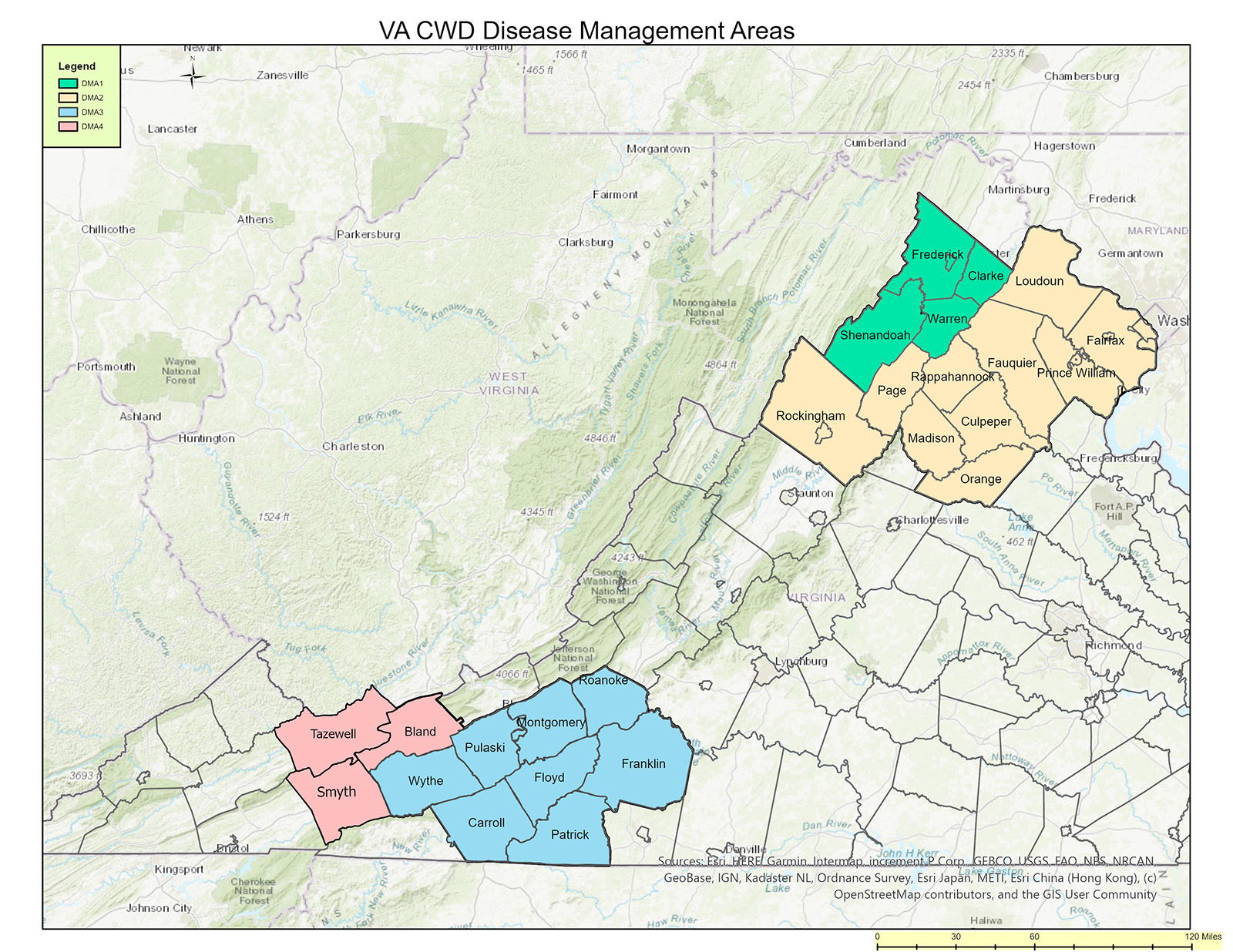
Map of 2025 CWD Disease Management Areas (DMAs). There are no DMA boundary changes for 2026.
In case you didn’t hear, CWD has now appeared on the Delmarva Peninsula. Delaware detected its first CWD-positive whitetail in Sussex County (their southernmost county). This leaves South Carolina as the only remaining southeastern state yet to detect CWD. For more information on CWD in Virginia, please visit the DWR website.
Hemorrhagic Disease Update
Epizootic Hemorrhagic Disease (EHD) and bluetongue virus (BTV), lumped together as simply Hemorrhagic Disease (HD), are common viral diseases that are often, but not always, fatal to white-tailed deer. Transmitted by a biting midge in the genus Culicoides, HD becomes more prevalent in late summer and early fall, especially following hot, dry summers that create ideal breeding conditions for the midges. Based on reports through the Wildlife Conflict Helpline and those given directly to DWR, HD activity was fairly quiet last year. We confirmed one relatively small outbreak in northern Virginia and scattered reports of suspect deaths elsewhere in the state that were not confirmed to be HD. While it was quiet in Virginia, HD was big news last year in southeastern Ohio and just across the border in West Virginia. Severe drought in the region set the stage for high midge abundance, and as we’ve seen in Virginia, where HD occurs less frequently (like WBR), the virus tends to be much more lethal to the deer that become infected. Fortunately, deer herds generally rebound within a few years of an HD outbreak.
New for Fall 2026
This deer season will largely look the same as last year, except we’ll be changing the counties in which we’ll conduct our Mandatory CWD Sampling Day. On November 14, mandatory CWD testing will occur in Bland, Grayson, Patrick, Shenandoah, Smyth, Tazewell, and Smyth counties.
Last year was a “reg year,” and since we revise our hunting regulations every other year, last year’s regulations will be in effect this fall as well. While the regulations will remain the same, we have rolled out a new printed hunting book this year. In the interest of reducing printing costs and simplifying how the information is presented, the printed version of the 2026-2027 hunting regulations book looks different than in years past. The printed version focuses on season dates, giving hunters easy access to be able to know what’s in season when. The online version of full regulations available on the DWR website will look the same and contain the full text of the regulations.
Tidewater Forecast
The deer harvest in Tidewater has been fairly stable at between 40,000 and 50,000 deer and most counties are meeting current population objectives; however, the growing human population is creating significant management challenges. Last year, we implemented Earn-a-Buck (EAB) in Chesterfield County and the early and late antlerless-only firearms seasons in Hanover, Henrico, and James City counties to help boost female harvest. Chesterfield saw a bump in percent females harvested (6 percentage points) and there were 119 antlerless deer taken during the antlerless firearms seasons in Hanover, but only 38 and 22 antlerless deer were taken in Henrico and James City counties, respectively, during those special antlerless seasons. We’ll need more does taken in these rapidly urbanizing counties to help minimize conflicts with deer. This is the reality we face in Tidewater and other urban areas across the state.
As shown in Figure 3, most counties in Tidewater are meeting their current population objective as laid out in the current Deer Management Plan, but these objectives may change with the new Deer Plan, which is being revised over the next year or so.
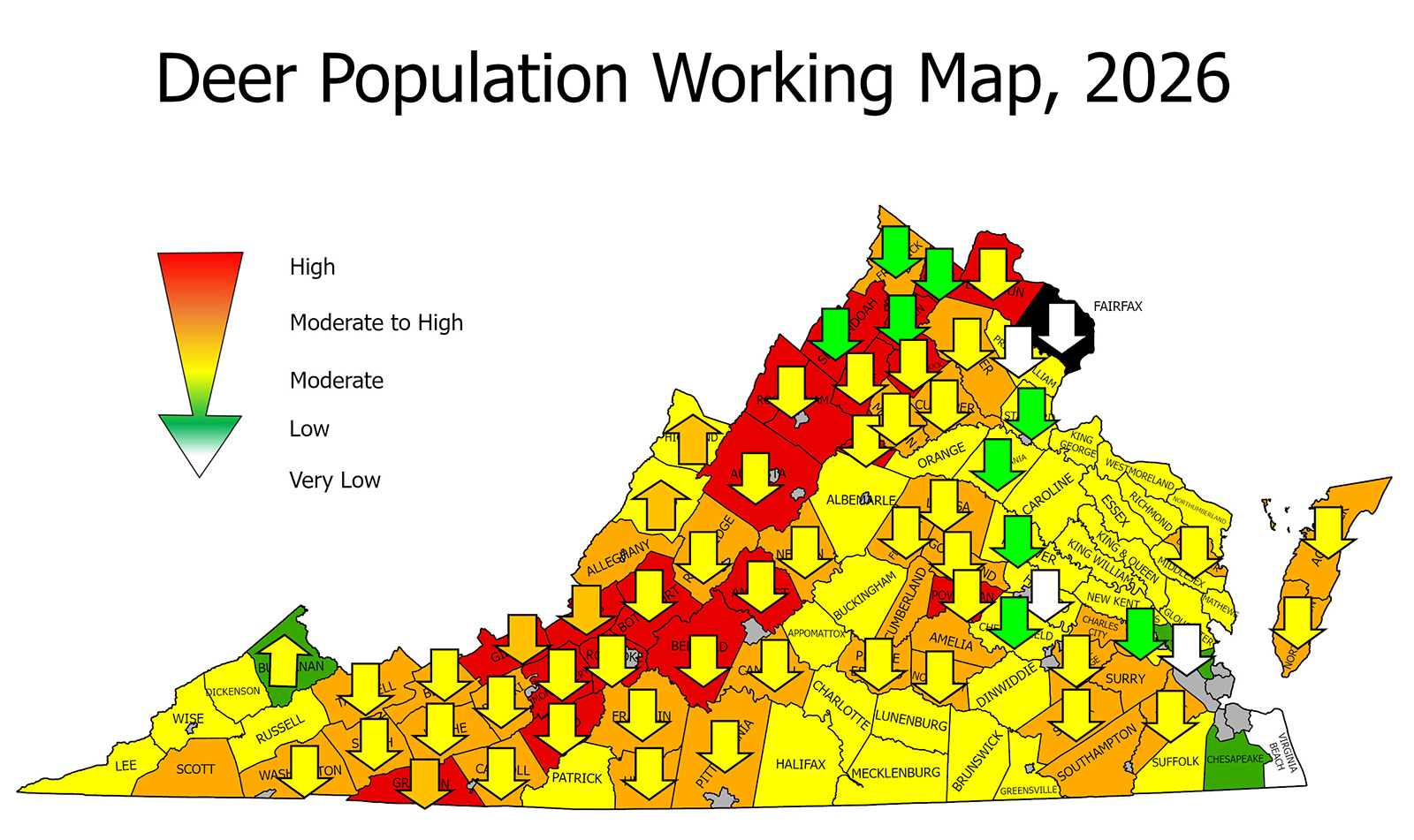
Figure 3: Map of private land deer population index after the end of the 2025 deer season. County colors represent relative deer population status. Arrow direction indicates the management goal and arrow color indicates management objective (e.g., a yellow arrow pointing downward indicates a goal of decreasing populations to a moderate level). A county with no arrow means it is meeting the population objective.
Southern Piedmont Forecast
If there is not a big HD event in this area in fall 2026, deer herds over most of this region should be relatively stable. The Southern Piedmont has had the highest deer harvest across all regions since 2020, with Bedford County having the highest total statewide at almost 9,000 deer harvested last season. As shown in Figure 3, over half of the deer herds in the Southern Piedmont are at their desired deer population level, but there’s work to be done in Bedford, Campbell, Chesterfield, Franklin, Henry, Nottoway, Pittsylvania, and Prince George counties.
Northern Piedmont Forecast
Over most of the Northern Piedmont, DWR continues to try reducing the deer population (see Figure 3), especially in Northern Virginia (NOVA)—Arlington, Fairfax, Loudoun, and Prince William counties—and in CWD DMA2. For the most part, the ultra-liberal NOVA deer seasons have been successful in reducing deer herds in Loudoun and Prince William counties, but not quite to the desired levels. Last year’s HD outbreak added some mortality, but likely not significant enough to make a big difference.
Stable to declining deer herds are expected and desired moving forward. Continued very high human population growth rates and deer-vehicle collisions remain important deer management issues in the Northern Piedmont (like Tidewater), and CWD is an ever-increasing problem here as well.
Northern Mountains Forecast
CWD continues to be a big issue in the Northern Mountains. On private lands in every county in the Shenandoah Valley, DWR is trying to reduce deer herds. Conversely, in the three Allegheny Highland counties (Alleghany, Bath, and Highland), DWR is trying to maintain moderate to high population levels (orange, Figure 3). Approximately two decades ago, all three of these counties exhibited a significant decline in deer populations. Since that time, regulations have been made more conservative and deer populations have stabilized and/or increased. Higher deer populations are desired and tolerated in the Allegheny Highlands because there are fewer people and not a lot of deer-human conflicts.
The severe ice storm that Virginia experienced this past winter was challenging for deer and other wildlife in this region. While we didn’t receive any reports of large die-offs in this area, I’m sure several deer starved or met their demise in other ways because of the ice (e.g., breaking legs, easy pickings for predators, etc.). Fortunately for deer in this area, the acorn crop was quite abundant, so most deer should have had plenty of fat reserves to rely on. It’s a rough life for deer up in the mountains where the habitat is poor and the winters can be harsh in some years, which is why hunting regulations remain conservative in many mountainous counties. Despite the ice up high, I would still expect deer numbers in the northern mountains to be relatively stable, and field staff reports support that.
A potential confounding variable in all of this could be the significant drought the entire state has been experiencing. As mentioned earlier, HD activity usually increases in drought years; on top of that, HD tends to be more lethal to deer in western Virginia where HD occurs less frequently. I wouldn’t be surprised if we see increased HD activity in our mountainous counties this summer/fall.
Southern Mountains Forecast
The Southern Mountains are best described by three different deer management approaches. In nearly all the counties in the New River Valley area, DWR is trying to reduce deer populations. Farther southwest, DWR is trying to maintain current/stable deer populations, and lastly, in Buchanan and Lee counties, DWR is still trying to increase deer populations. These efforts have been and continue to be successful, and we added some either-sex harvest opportunity in far Southwest Virginia last year.
Feedback from hunters and our staff there suggests a growing deer population and a need for increased doe harvest in some areas. We will evaluate closely during our next regulations amendment process that begins this fall. I expect ice impacts in the Southern Mountains to be similar to those in the Northern Mountains—deer at high elevations may have struggled somewhat, while those in the valleys did okay. As with the Northern Mountains, we could see some increased HD activity due to the ongoing drought.
Relative Deer Abundance Map
The best way to compare deer populations in Virginia is based on the antlered buck deer harvest per square mile of estimated deer habitat. This is the population index we use to monitor deer population trends over time. Figure 3 shows the relative differences among counties in the harvest of antlered bucks per square mile of habitat on private land, averaged over the past three hunting seasons. There are 97 major deer management units in Virginia. In 56 units (58%), DWR is actively managing to reduce deer populations. In 38 management units, DWR is actively managing to maintain current deer population levels; and lastly, in only three management units, DWR is actively managing to increase deer numbers.
Summary
So, what is the forecast for the fall 2026 deer season? Unless there is a significant HD event—which may very well occur because of the ongoing drought—deer populations and the deer harvest across most of the state should be stable to increasing. Time will tell.
Even with HD and our liberal deer hunting regulations, we’re unlikely to overshoot our population objectives, and we will still need to make more progress in many overpopulated counties. Over the past 30 years, the statewide annual deer harvest has been relatively stable and ranged from about 179,000 to 259,000 and averaged about 212,000 (see Figure 4), with some severe winters and big HD years sprinkled in over that time. Despite severe weather events and increasingly liberal harvest regulations in many areas, our statewide deer population estimates continue to increase, showing just how productive and resilient our deer herds are in the Commonwealth.
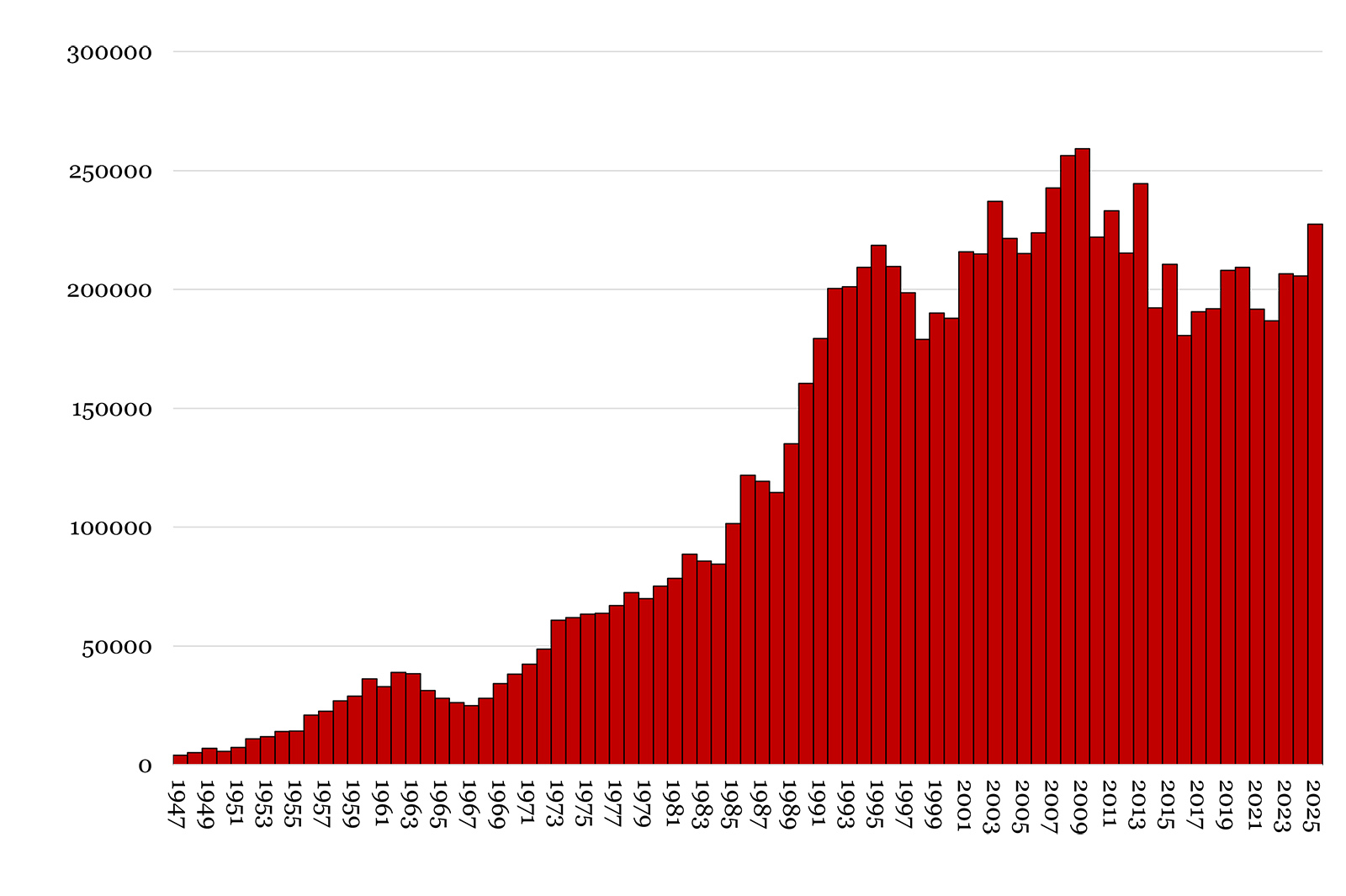
Figure 4: Statewide deer harvest totals from 1947-2025.
Past experience indicates that the ups and downs in annual deer harvest totals are in part attributable to mast conditions and/or HD outbreaks, neither of which we can predict. In years of poor mast crops, the deer harvest typically goes up. In years of good mast crops, the deer harvest typically goes down. Persons interested in more information on Virginia’s deer management program can look at DWR’s deer management plan.
Please support the Virginia Hunters for the Hungry program, do not feed the deer, and, most importantly, be safe.
