
By Bruce Ingram for Whitetail Times
As the executive director of the Virginia Department of Wildlife Resources (DWR), Ryan Brown has a great many things to keep abreast of including, of course, hunting and fishing. Those two pastimes have long been a part of his life, as he grew up a Fork Union farm boy in Fluvanna County. Indeed, Brown spent his youth hunting and fishing when not working on the family spread.
Later, the native Virginian earned a law degree at the University of Richmond in 2005, then had stops at the Virginia Department of Conservation and Recreation, the Virginia Attorney General’s office, and a stint as the Legislative and Policy Manager for the then-Virginia Department of Game and Inland Fisheries (now DWR) before entering private practice as an attorney. But when DWR Executive Director Bob Duncan retired and Brown received an offer to become Duncan’s replacement, Brown enthusiastically returned to his outdoor roots. He also currently serves as Chair of the Executive Committee of the National Association of Fish and Wildlife Agencies and was recently elected President of the Southeastern Association of Fish and Wildlife Agencies.
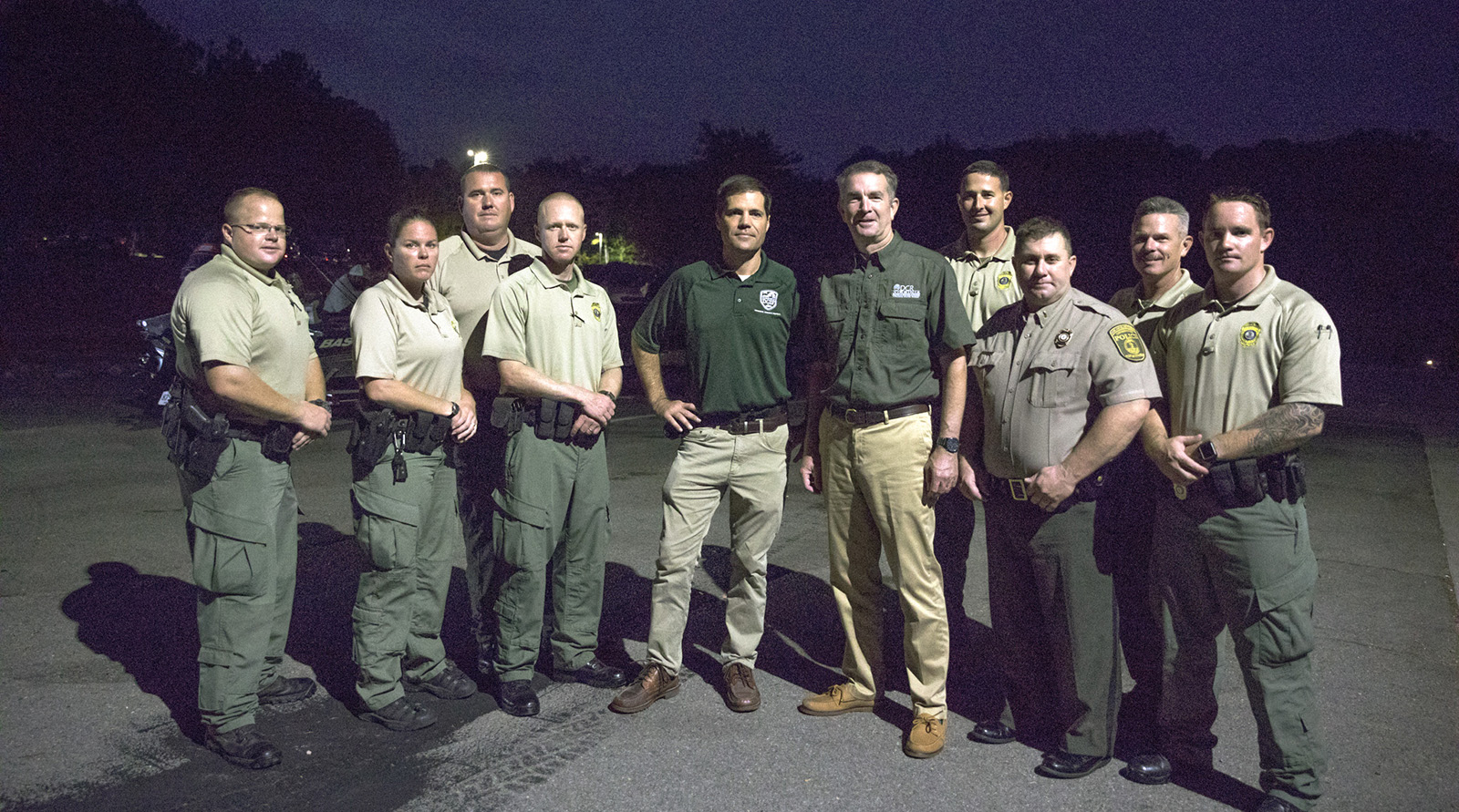
DWR Executive Director Ryan Brown (center left) works closely with the Law Enforcement division at DWR. Working with Colonel Cobb and his field force of Conservation Police Officers is an important part of this working relationship and is what he strives for with all the agency’s employees.
Following is a conversation I had with the director about deer hunting’s present and future in the Old Dominion.
Chronic Wasting Disease Concerns
Certainly, one of the most important topics on deer hunters’ minds is Chronic Wasting Disease (CWD). Currently, several of the ways DWR is dealing with this plague are through its Disease Management Areas and having mandatory and voluntary CWD testing, depending on the circumstances.
“I have often bragged to my regional and national department directors and wildlife biologists about the positive responses we’ve received from Virginia’s hunters on our goal of slowing the spread of CWD in the state,” Brown said. “Their response has been tremendous and a great help to our efforts. CWD is going to be with us for a long time. It’s still relatively new to this region, so we don’t have any computer simulation about what is likely to be the long-term effects and what CWD will look like in Virginia 10 or 20 years from now.
“We have to recognize that CWD can’t be eliminated at the present. And it’s unknowable if there will ever be a cure. But it’s also difficult to imagine that, in a wild deer population, it could ever be completely eliminated. Right now, one of the things that biologists are hopeful for is that there will one day be an easier way to test for CWD than pulling lymph nodes, sending them to a lab, having them tested, and then letting hunters know that their deer tested positive or negative.”
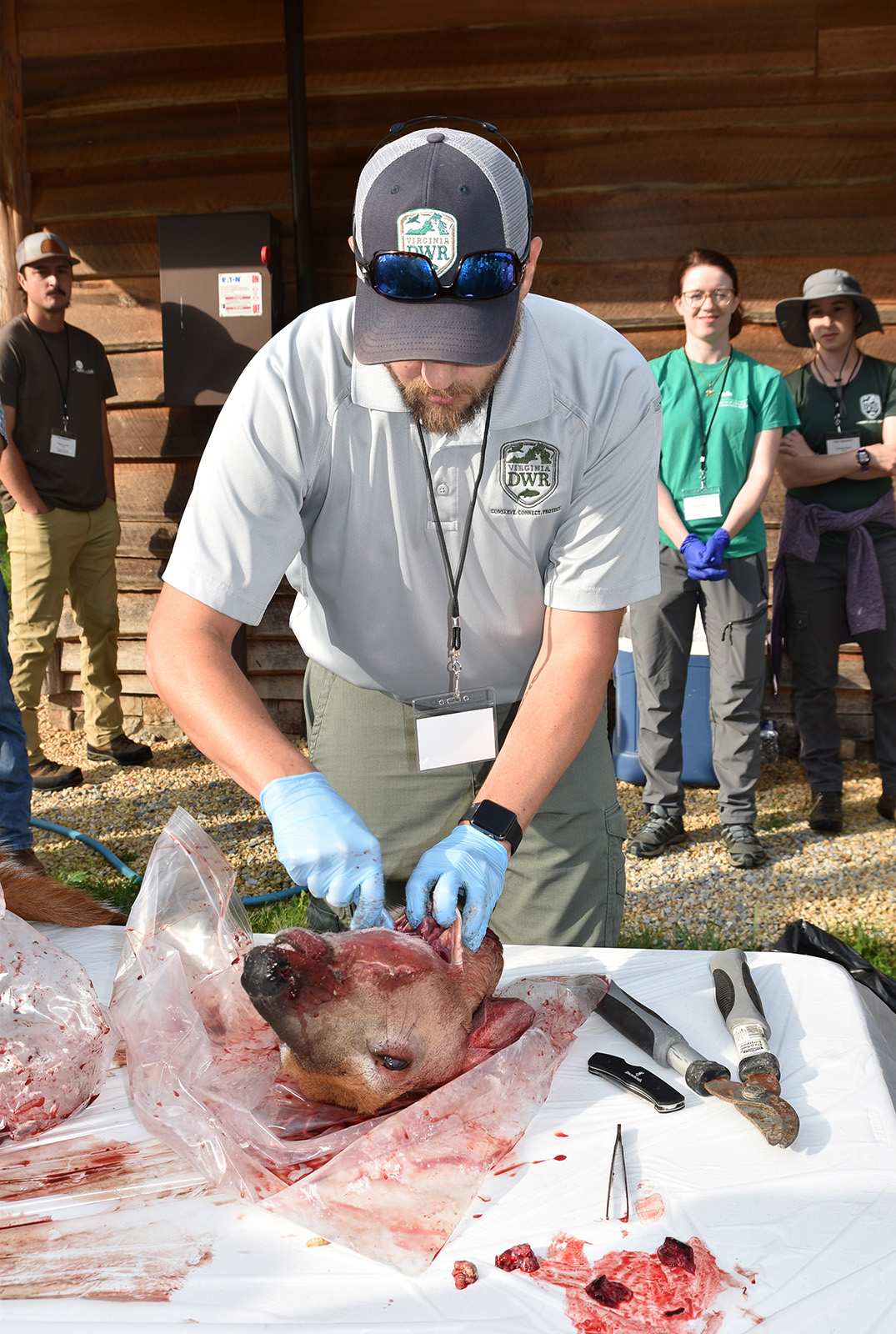
Justin Folks, the DWR Deer Project Coordinator, extracting lymph nodes from a deer for CWD testing. The deer management plan plays a major role in DWR’s work. Photo by Meghan Marchetti, VA DWR
Ideally, continued Brown, a faster testing process would involve the hunter being able to do the testing himself. Encouragingly, on the national front, there was bipartisan support for the Chronic Wasting Disease Research and Management Act, which passed Congress in December of 2022. Brown believes that the nation’s sportsmen and women will see that investment continue. In short, what DWR is doing now is essentially based on national best management practices.
Recruitment of New Hunters
According to a U.S. Fish and Wildlife Services (USFWS) survey in 2022, only about six percent of America’s population hunts. In the Commonwealth, about 90 percent of the 248,000 licensed hunters pursue deer. That figure does not include hunters who are exempt from licensing requirements, including landowners who hunt only on their own property. DWR has been active in the R3 movement: to recruit, retain, and reactivate hunters.
“DWR has been conducting numerous outreach programs to youth and adults not from a hunting background to the sport,” Brown said. “Many of these individuals may be from urban and suburban areas and not have had any experience with hunting, but they have an interest in doing so.”
The 44-year-old Brown knows firsthand the joy of seeing a youngster harvest a deer.
“Some of my best memories are hunting with my daughter; this past fall, that included watching her harvest a buck and a doe on the same Fluvanna County farm that I grew up hunting on,” he said.
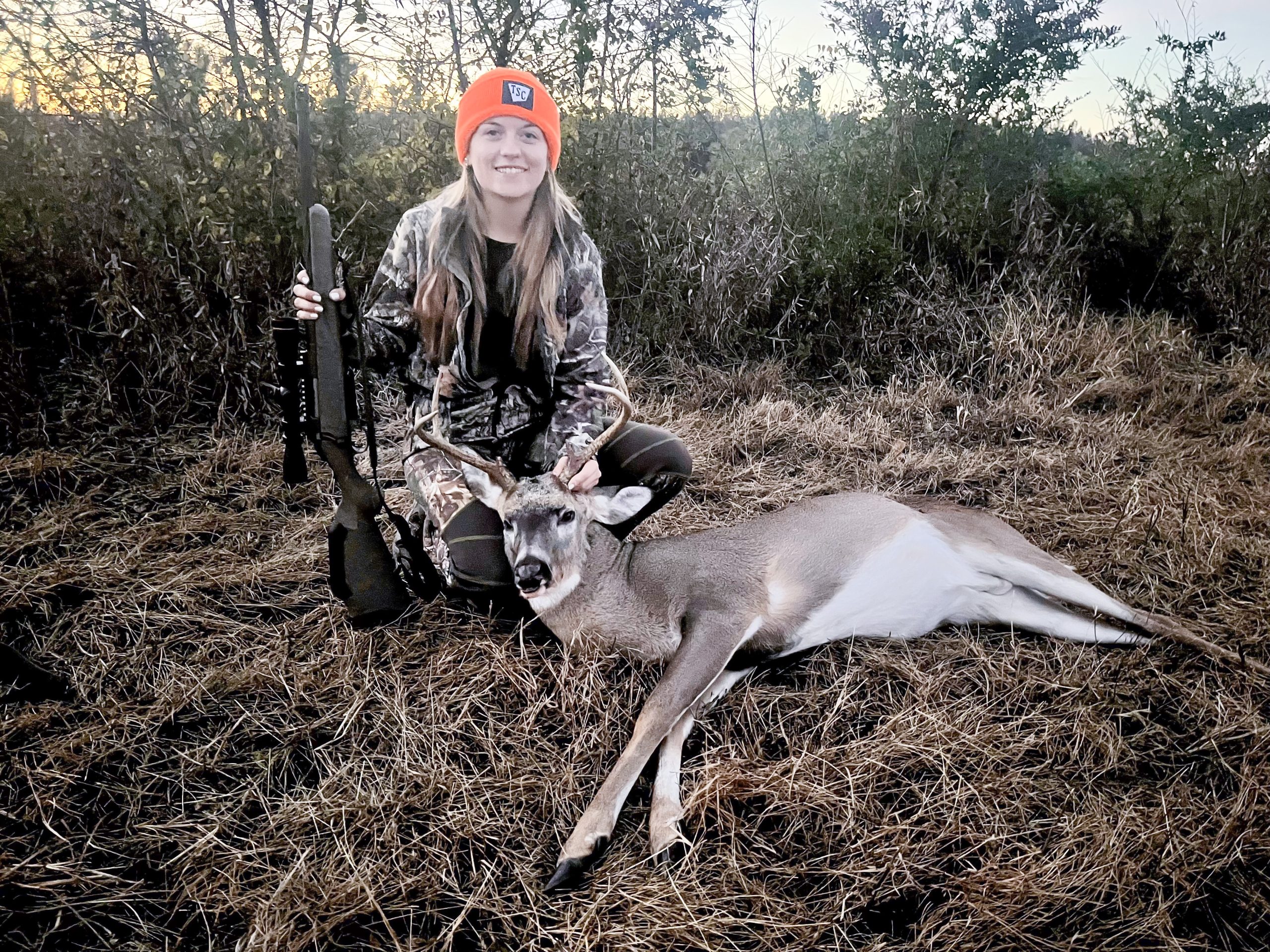
Brown works closely with DWR’s Outreach Department to promote more youth hunting opportunities. He takes great pride in the time he spends hunting with his daughter, Lainey. Photo courtesy of Ryan Brown
Outreach to non-hunting adults is also an important part of DWR’s mission. I told Brown that I did not grow up in a family where anyone hunted or fished, and that I was 33 years old when I first went hunting in 1985. I quickly became enamored with the pastime and also became what is known today as an “adult-onset hunter.” This is sometimes defined as individuals 20 or more years old who take up hunting for a variety of reasons. Those reasons often include hunting for meat and simply enjoying being outdoors, which is why I wanted to hunt. Typically, these adult-onset hunters have little interest in pursuing trophy deer.
“Today, your story of how you began hunting is more typical than you might think,” Brown told me. “DWR has workshops where we pair adults who did not hunt as children with veteran hunters. These potential new hunters are also often very receptive to the idea of harvesting does as part of herd management health, as well as having the desire to bring food home to their family,” Brown continued.
“These workshops have become so popular that there have been times when people had to be put on waiting lists. One of the best things about introducing adults to hunting is if they decide to make the time to go hunt, they will typically stick with it. And if the adults become involved, then there’s a good chance that their children will give hunting a try. We’ve also done outreach to groups that are already involved with the outdoors such as anglers, hikers, and campers. We engage and encourage them to take an additional step to a new activity.”
Brown praised the work of David Hennaman, R3 coordinator for DWR, who has worked tirelessly to introduce both youth and adults to the outdoors and hunting.
Hemorrhagic Disease
Hemorrhagic Disease (HD) is a catch-all term for two closely related afflictions: Epizootic Hemorrhagic Disease (EHD) virus and Bluetongue (BT) virus. The former is more common in our state. Midges, sometimes called no-see-ums, transmit these diseases, often plaguing deer in the summer and fall, but these insects historically have died after the first hard frost. But with climate change and warmer temperatures, midges are now more abundant and active longer. Biologically, HD outbreaks are often more severe in deer herds that have not been exposed to it before. High density herds are more prone to higher death rates.
“We are aware of how higher temperatures could affect the spread of HD,” Brown said. “HD is creeping further north in this region, and we are seeing it in places where we had not seen it before. And, of course, biologists are studying this. Deer are very adaptable creatures, and they will adapt to the warmer temperatures. Over the long term, there could be a very gradual change to deer breeding behavior and the rut period. Across the country, the rut occurs at different times as hunters know.”
The Need for Virginia Hunters to Harvest More Does
Interestingly, Brown speculated and worried on how warmer temperatures could affect hunter participation and behavior. When fall temperatures are 75 to 80 degrees, it’s understandable, he said, that an individual might forego going afield until the weather becomes cooler. Even in the Southwest Virginia mountains where I live, there were two November afternoons this past year when the temperature topped out at 82 and 83 during the early stages of the rut.
“Virginia hunters have a passion for their sport and care about the conservation of the deer species,” Brown said. “Deer are plentiful in many parts of the state, and too plentiful in some areas. Part of our duty as hunters and conservationists is to manage the herd, and doe harvest is a strong component of that.
“Personally, I enjoy hunting for mature bucks and the challenge of it. But with our large number of deer, I know I need to hunt for does to control the population,” Brown said. “We are not harvesting enough does. I try to kill 10 deer a year with one to three of them being bucks. When I’m done filling my freezer for the year, I contribute deer to Virginia’s Hunters for the Hungry (HFTH) and also give venison to friends.”
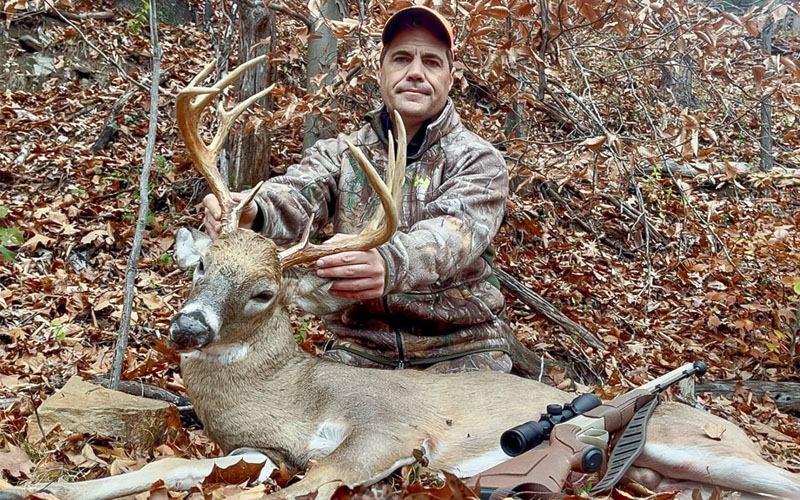
Brown harvested this buck during the 2024 muzzleloader season in Fluvanna County on the farm he hunted growing up. He said, “I’ve taken deer at this same spot from my teenage years to current.” Photo courtesy of Ryan Brown
Brown encourages deer hunters to support HFTH and to share the bounty of the hunt with non-hunters. As someone who, like Brown, tries to harvest 10 deer annually and whose primary goal as a deer hunter is to gain enough venison so that I don’t have to purchase store meat, I have a profound respect for does, and the challenge of outwitting a mature one.
“Doe hunting is a lot of fun and a challenge,” Brown said. “A very smart, old doe might not come with antlers, but don’t underestimate her. She is a worthy adversary. Again, our herd management depends on doe harvests.”
Virginia’s hunters, anglers, and outdoor enthusiasts are fortunate to have Brown as DWR executive director.
Thoughts from David Hennaman, R3 coordinator for DWR
“My job is to make a person a good hunter, angler, and conservationist, and that’s a joy to do,” Hennaman said. “We’ve been having a lot of success with adult-onset hunters. These are people largely wanting to hunt for sustenance, health, or economic reasons. They are typically not interested in trophy hunting.
“We’ve also found that many of these people are interested in wanting to know what the deer they’ve harvested have been eating, how to field dress and butcher their deer, and how to prepare the meat.”
Hennaman also shared that these adult-onset hunters seem to understand that with the inexpensive apprentice license and, later, the regular licenses that these individuals are beginning a new pastime at bargain prices. With those fees, they also gain admission to state Wildlife Management Areas (WMA). And, to briefly editorialize, he’s right. Obviously, other hunting-related expenses occur, but license fees are not a barrier to entry. The R3 coordinator also offered another observation.
“We’ve noticed that when new hunters come back for another workshop, they often bring a friend with them who is also interested in trying hunting,” he said.
Thoughts from DWR Deer Project Leader Justin Folks on the future of our state’s deer hunting
“I think the future of CWD depends on our constituents,” said Folks. “We need buy-in from hunters to help reduce deer densities where necessary, assist with our sampling efforts, and to limit prion exposure on the landscape. We also need buy-in from the public at large in not feeding deer. With public buy-in and assistance, I think we can keep CWD somewhat manageable. It’s never going away, but if we don’t get cooperation from our constituents, CWD could have serious impacts on our deer herds across the state. I also hope that additional research over the next 10 years may provide easier/quicker testing and I hope more research will support that CWD won’t be infectious to humans or other wildlife.
Folks noted that the hunting community has responded and helped to reduce deer numbers in CWD areas. “I believe it has helped slow the spread of the disease,” he said. “I’d hate to know what things would look like if we hadn’t reduced deer numbers in Northwest Virginia.
“Urban deer management is, and will continue to be, a challenge as urban sprawl turns otherwise hunted/huntable areas into de facto deer sanctuaries with increasing deer-human conflicts. CWD will always be a challenge. Managing increasing deer numbers with a declining hunter base will be a challenge,” said Folks.
Folks doesn’t see climate change as driving changes in deer behavior. “But there could be a shift in peak breeding over the very long term,” he said. “If anything changes, it will be very gradual.
“I do anticipate EHD becoming more prevalent in the near term, and having bigger impacts in the western part of Virginia, where it has been historically rare. EHD outbreaks are creeping further north in the United States already,” said Folks.
“Regarding the problems of decreasing hunters and increasing deer numbers, I think we need to address this from both ends—recruiting more hunters and trying to get the hunters we still have to take more does,” Folks concluded.
Bruce Ingram, a serious whitetail hunter and fisherman, lives in Fincastle, Virginia with his family. His hunting and fishing articles have been published in state, regional, and national publications.