
By Mike Dye/DWR
Photos by Mike Roberts
In the 2025 spring turkey season, turkey hunters bagged a total of 61 bearded hens. To some of those hunters, that bearded hen represented a trophy; to others, it may have been the only legal turkey they encountered. Virginia’s regulation for spring turkey season allows the harvest of bearded turkeys, which typically includes a small number of bearded hens. With the growing concern for turkey populations here in Virginia and nationally, many hunters have been asking why we allow the harvest of a hen during these spring seasons.
What is a bearded hen?
Let’s start off discussing what a bearded hen is and what it is not. A turkey beard is simply a clump of bristle-like modified feathers that grow in the chest area of a turkey. Beards are typically attributed to male turkeys (gobblers) although a small portion of females (hens) can develop a beard. Typically, hens do not develop beards that are as thick as gobblers, but they can be visible at closer distances. Approximately four to five percent of turkey hens will develop a beard, although we do see a higher percentage in some localized areas (possibly a genetic influence).
While we don’t know the exact mechanism that causes some hens to develop a beard, we do know that a bearded hen is capable of full reproduction, unlike an antlered whitetail doe, which is often infertile. It is not believed to be a result of hormonal imbalances or altered sexual organ development (as is often the case with antlered does). Some hunters may take bearded hens assuming that they are infertile due to the presence of a beard; however, there is no evidence that this is the case.
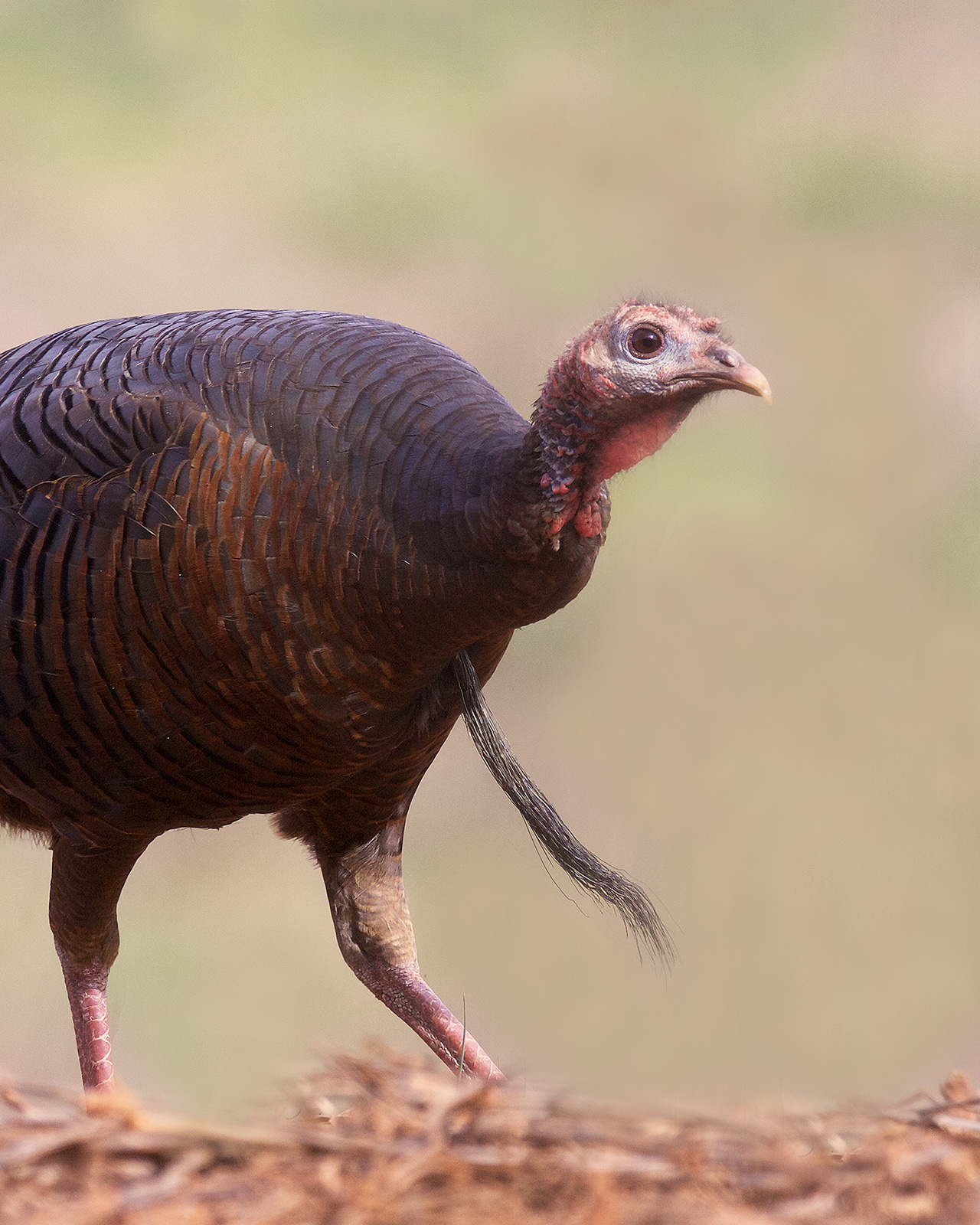
A bearded hen.
The presence of a beard on a hen can often be an indicator of age to some degree. Beards take time to grow and develop, often taking one to two years to become visible. Because of this, the presence of a visible beard may be a sign that the hen has survived for more than two years. This can be a very important fact given that we know from previous research here in Virginia and elsewhere that older females account for more successful nests and poults than younger females. Because older hens are generally more productive, if you have a property goal of increasing turkey populations, protecting bearded hens may be advisable.
So why allow hunters to kill bearded hens?
Many seasoned turkey hunters can easily identify a bearded hen, although less experienced hunters may not have that ability. New hunters may have more difficulty distinguishing the sex of a turkey based on other characteristics (plumage color, feathering on the head, or head color). In fact, even seasoned hunters and biologists may be fooled on occasion. In that sense, prohibiting the harvest of bearded hens can become a barrier to entry for some of our newer hunters. They may choose not to participate in spring gobbler seasons if they are afraid of making a mistake.
While several states prohibit the take of bearded hens, Virginia has chosen to allow their take. In some situations, hunters may mistake a hen as a gobbler based on head or feather color characteristics that are not 100 percent reliable indicators of sex. These situations could put our law enforcement on the spot as they must make a judgement about whether it was reasonable for the hunter to take the turkey. As the regulation is currently written, the defining line is a visible beard. That is easily defensible and clear to law enforcement personnel, with little to no gray area to interpret.
Given that only four to five percent of the hen population is at risk of harvest through the current regulation, and the fact that hunters are not currently taking large numbers of bearded hens, biologists do not feel that the regulation is placing the statewide turkey population at a risk. However, as noted above, these hens may be older and more productive contributors to the localized populations. For this reason alone, many hunters and managers find that protecting these hens is important.
Recent survey data indicates that hunters are somewhat split on the issue of harvesting a bearded hen in the spring season. Results from the 2023-24 biennial Hunter Survey indicated that approximately 28 percent of hunters found taking a bearded hen acceptable during the spring season, while 36 percent indicated that it was not acceptable.
Over the years, some hunters have reported taking a bearded hen thinking that they harvested something unique or rare. To them, that bird was a rare sight and was considered a trophy animal. While a bearded hen is not something you see regularly, they are not as uncommon as you may think.
As with so many things in wildlife management, there are positives and negatives that we must factor into hunting regulations. Saving 61 additional potential breeding hens could have a positive impact on localized populations. However, since those 61 hens taken during the 2025 spring season were actually spread across the state, it is unlikely that the impact is measurable.
By the same token, some of those hens represented a unique experience for the hunter who chose to pull the trigger. These intersections of hunter preferences and biology are often tricky for state wildlife agencies to navigate. While prohibiting bearded hens might be of a small benefit to the population, there would be a cost for hunters in terms of difficulty making decisions afield and reduced satisfaction. At the end of the day, it is up to each of us as hunters to make the decision that is right and it is up to each of us to understand why it is right for our situation.
Mike Dye is DWR’s Forest Gamebird Biologist – Turkey and Grouse.
