
By Phil Czajkowski
Photos by Phil Czajkowski
Any day in the woods is a good day, but some are more memorable than others…
The morning of the mentored population control hunt at Widewater State Park was slow, as I sat in the blind with my mentor, Derek. It was cold, at least by Virginia standards, and as the chill set into our bones, time seemed to move even slower. The only sound was the honking of some Canada geese paddling around on the Potomac River, and the constant rustle of a dozen or so squirrels that were scurrying around in the brush and trees all around us. We sat in the blind for most of the morning and decided to take a break for lunch and try our luck in a different zone that afternoon.
After a quick break to warm up and eat a few snacks, my mentor and I made our way to our new hunting zone. This new spot was situated on the southern tip of the Widewater Park peninsula. The area was an old homesite, with a dilapidated house in the center of the property and the area was covered in hardwoods and patches of thick underbrush. We followed an old access road towards the center of the zone, and I settled into a spot next to a tree about 100 yards from the old house along the access road, hoping to catch a deer coming out to browse along the road edge.
After sitting for an hour or so, I caught movement out of the corner of my eye, in a thick patch of brush. Thinking it was yet another squirrel scampering along, trying to distract me, I was surprised to make out the partial outline of a doe grazing along in the woods about 50 yards away. I sat and watched as she moved out of my line of sight and was replaced by yet another deer and then a third.
I slowly turned my body to face the direction that I had seen the deer, desperately hoping that my movement didn’t tip the deer off to my presence. By the time I had repositioned myself, the deer had disappeared from view in the thick brush and trees now in front of me. I sat and bored a hole in the woods with my eyes trying to get a glimpse of the deer, willing them to come into view. Had they wandered off? Did my movement spook them? Did I imagine the whole thing? After about 20 minutes of intense staring, I was about to give up and reorient myself to my original position when I saw a flicker of movement in the brush.
Sure enough, as I watched, I caught brief glimpses of a deer grazing along in the thick undergrowth ahead of me. So, I sat and stared for what seemed like an eternity, occasionally bringing my shotgun up, hoping to get a shot through an opening in the scrub, but I just couldn’t get a clear shot.
After almost an hour, the deer had drifted to a clearing in the woods. Sure enough, as I watched, a doe walked out, followed by a slightly smaller doe and a yearling. I slowly pulled my shotgun up and settled my crosshairs on the lead doe and waited for my chance. As I tracked the doe with my shotgun, I could feel my heart pounding and it took considerable effort to keep my breathing slow and steady. Finally, the doe stopped about 60 yards away, quartering slightly away from me. As I looked through the scope, I tried to settle my wobbling crosshairs on the spot just behind the doe’s shoulder and slowly squeezed off my shot.
At the shot, the doe bolted and chaos ensued. I quickly reloaded my single shot shotgun with another slug, while simultaneously trying to track the doe I had shot at, hoping to see some indication that I had hit her and what direction she was running. At the same time, much to my astonishment, the woods exploded with deer!
I had thought that the deer I shot at was accompanied by two other deer, but the reality was there were at least 10 hidden away in the undergrowth. Even more astonishing was that as I scanned the tree line, trying to make sense of the frenzy of deer in front of me, my eyes locked onto the distinct silhouette of a deer’s head and shoulders perfectly broadside to me about 45 yards to my front. I hesitated for just a second, and realized this was a population control hunt! If I had the chance to take more than one deer, I should. So, I raised my shotgun again and wrestled my crosshairs onto the shoulder of the deer to my front and snapped off another shot. The deer stood unmoving for a second and then disappeared from my sight. Panting from excitement at this point, I reloaded and watched as the last of the flagging white tails disappeared into the brush and out of sight.
With my heart pounding, I was stunned. Two shots at two deer in less than a minute! My mentor talked me down and helped me to relax as we waited to give the deer a chance to expire. Neither of the deer I had shot at had dropped within sight of us, and in all the excitement, I couldn’t be sure of my shots. I thought I had gotten at least one good shot in, but I wasn’t positive. After a bit of time had passed, my mentor had me stand at my shooting location and guide him to the spot where I took my shots. My mentor found a few spots of blood at one of the spots where I thought I had shot a deer, but not at the other. The ground was churned up from all the deer running off in all directions, so tracking alone wasn’t going to tell us much.
We spent a few minutes surveying the area and found one definite blood trail and concluded I must have cleanly missed the second deer, since there was no immediate reaction to my shot and the fact that it just seemed to disappear. Given the pandemonium after my first shot, it was easy to believe that I pulled a shot in all the excitement, so we focused on the one blood trail we had.
We quickly found more blood and even a few strands of hair, and after about 30 yards, we found a yearling spike buck piled up near some brush. I had thought the first deer I had shot had been a doe, but the spike’s antlers were short, so it was entirely possible I just didn’t notice them. My mentor walked me through field dressing the deer and after a few minutes of handshakes and giving thanks, we started dragging the spike out of the woods and back to the trail we had come in on. If that had been the end of the story, it would have been a good day…
As we made our way back to our gear and the trail, my mentor looked over and noticed an exceptionally unique looking skunk. The skunk had caught his eye because it didn’t have the typical black and white stripes down its back but instead had a single really wide and fluffy-looking white stripe, making the skunk look almost completely white. The skunk’s appearance was so unique that it distracted us both for a second and we didn’t realize what the skunk was doing out in the open, in the middle of the afternoon.
It turns out that our newly found friend had located and was laying claim to a freshly downed deer! After a few minutes of debate, my mentor was able to coax the skunk away from the downed deer by talking to it. It turns out that skunks are easily distracted by conversations!?! Who knew?
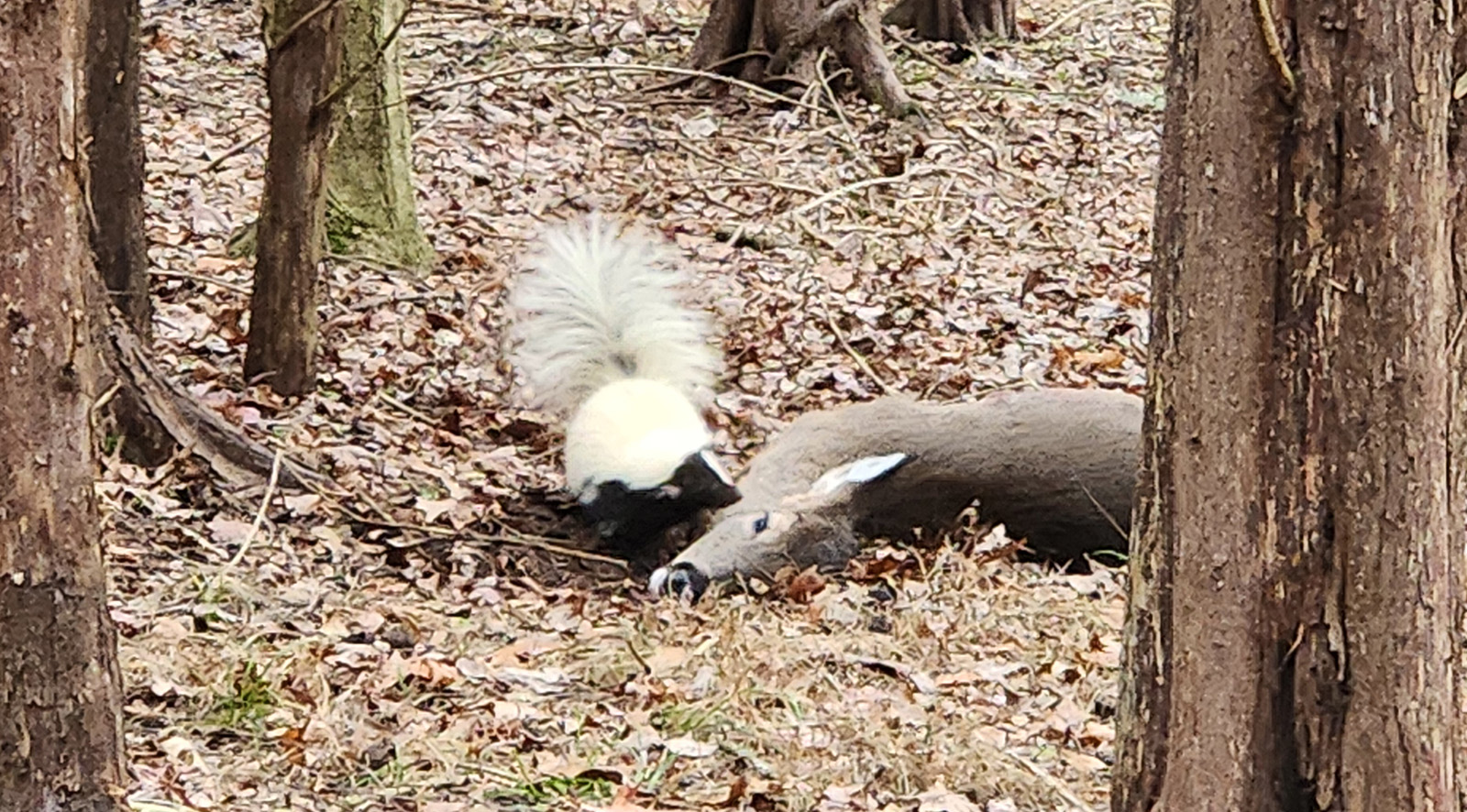
This unusual skunk helped us locate the second deer.
Once our little friend wandered off, we checked the deer, and sure enough, it was still warm. This was definitely the doe I had shot at first. We were a little baffled as to why we didn’t find evidence that she had been hit? After checking the doe and the surrounding area, we concluded that the slug from my shotgun had hit the deer in the lungs and somehow deflected into the body, taking out the liver and other organs. Because there was only an entrance wound, there was virtually no blood for us to find. In any case, the doe had only traveled about 20 yards from where she had been shot.
That mystery solved, we dressed out the doe and proceeded to do the long drag back to the truck. I’m grateful to have had my mentor with me, not only for the great advice and encouragement, but to help with hauling those deer back to the truck.
To say that this hunt was a success would be a gross understatement. Not only was this my first two-fer on deer, but I’ve also never recovered a deer with the help of a skunk! Most importantly, I learned a ton of new things, thanks to my outstanding hunting mentor Derek, and the awesome instruction and coaching from the Viginia Department of Wildlife Resources (DWR) staff and volunteers, particularly Jason Miller and volunteer Bob Wolz. The DWR hunter education program has helped me take my hunting knowledge and skills to the next level and I’ve met a bunch of great fellow hunters. I definitely sing their praises and recommend the hunter education program whenever I can. I hope the DWR Hunter Education program continues and expands into other training opportunities for new and old hunters alike!
