
By Master Conservation Police Officer Eric Dotterer for Whitetail Times
The Virginia Department of Game and Inland Fisheries (DGIF)—now the Virginia Department of Wildlife Resources (DWR)—began a new era in the 1980s, one brought to fruition after decades of conservation work to save the Commonwealth’s overharvested native species. Population booms brought more hunters into the field, resulting in stricter regulations to prevent the recurrence of past mistakes. Once the DGIF received law enforcement powers in 1982, the local game warden became an invaluable protector and enforcer of these guidelines.
Early in his career, Game Warden Rick Perry developed a mindset grounded in detection and perseverance. Assigned to Henrico County in 1978, Perry routinely monitored several bodies of water, including the Pamunkey River. With limited human presence, this river became home to flourishing wildlife populations of ducks, geese, deer, and turkey. Remote areas tend to be mysterious, and Perry had heard the rumors of dogs being used to chase deer into the river while poachers waited to take advantage. Without solid evidence, the matter would stay shrouded for years.
A break came near the end of 1984, when Perry received a tip from a trusted source. A trapper familiar with the Pamunkey advised the rumors held weight. Bolstered by this firsthand information, Perry began to devise a plan to find the truth. Relying on personal knowledge and maps of the area, he scouted the adjacent canals, thoroughfares, and islands on the small jon boat he had been issued. After locating the best vantage points on the river and securing access to the closest private boat launch, the date was set to execute the plan.
The night before leaving, Perry hooked the jon boat to his Ford Crown Vic and provided the float plan to his wife with instructions should he not return by nightfall. Communication would be limited to the vehicle’s police radio, and service coverage would not begin until 0800. Armed only with his personal Smith & Wesson .357 Magnum, Perry set out at 0330 into the frigid January morning. After launching, he traveled downstream, remaining almost invisible in the cold darkness.
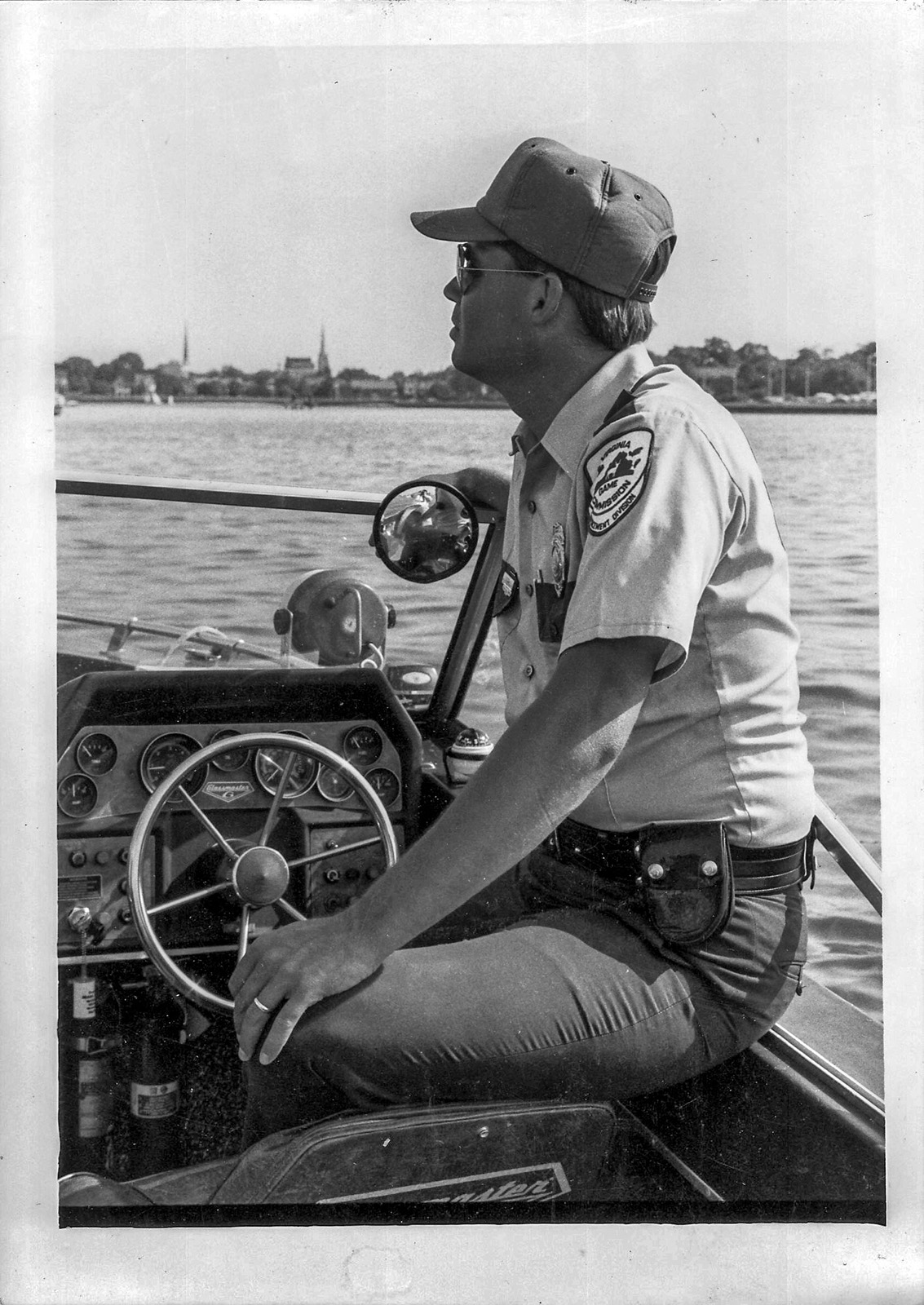
Game Warden Perry at the helm of his issued 18’ V-hull Glassmaster. The vessel had a top speed of 55 mph, making it one of the fastest on the water circa 1985. Photo courtsey of Game Warden Rick Perry
Halfway to the vantage point, the boat’s 18hp motor sputtered and died. The still silence was suddenly broken by an outboard starting on the opposite shore. With the engine primed and choked, yet refusing to turn over, Perry determined water was in the tank and quickly worked to unhook and syphon the line. Once it was reattached and primed—the heat was on. He navigated to the location and settled into the chosen creek. Covering the bow with camo netting, he began watch with his trusty Tascos.
As the sky began to lighten, the sound of an approaching boat could be heard. Three men traveled past Perry down the river to a duck blind several hundred yards away. They proceeded to throw out decoys and began to call after they were settled into the blind.
The morning became bright and clear as more boats could be heard traveling on the river. Then Perry heard the distinguishable sound of barking dogs coming from the island. Meanwhile, the duck calls had yielded results, and the hunters in the blind were taking and retrieving successfully—yet Perry detected additional shots had been fired.
Simultaneously, a nearby boat had stopped, fired rounds, then restarted and entered the thoroughfare, proceeding first past the blind, then his location. The occupants—two men and a young boy—continued to the main river channel. Again, the boat stopped, and several more shots were fired. Minutes passed, the boat restarted, and they proceeded upriver.
Once more, Perry heard the dogs barking on the island when, suddenly, the men in the blind hunkered down, out of sight. Tascos in hand, he spied a huge buck—a bruiser with a wide and high set of 10-plus points—enter the water and begin to swim towards the blind. All three hunters rose as one, barrels blazing, and opened fire on the trophy. Survival instincts activated, the buck changed course, and after deftly dodging a steady barrage of lead from multiple reloads, he arrived at the opposite bank and escaped into the woods.
Perry removed his boat’s camo netting and proceeded to the blind. After identifying himself, he asked the hunters to exit the blind and leave their guns behind. He obtained their hunting licenses and pocketed them for future reference. Perry began to question the hunters when the boat from earlier returned on scene with the two men and young boy. He ordered the hunters to remain outside the blind while he approached the boat.
Perry made it to shore and attempted to hail the boat, identifying himself and showing his badge of authority, but was completely ignored. As the hunters watched, he began to run alongside the bank, yelling louder at the boat to stop. The driver finally cut the engine and came to shore 25 yards from the blind. Upon arrival, Perry observed that with them in the boat were two shotguns and three soaking wet doe deer. He asked who had killed the deer. The 8-year old boy’s immediate denial was quickly covered by dad’s adamant insistence that they had each taken one. They were asked to stand on the bank away from the boat and guns while Perry went back to the three hunters at the blind.
In the time he had been away, the hunters had become agitated. With hushed whispers and hostile attitudes, Perry believed they had devised a plan of attack when, in his peripheral, he spotted the father in the boat with the deer. Yelling for him to get out of the boat and back to the bank, Perry turned and advised the hunters that he had two other wardens on the island and would call on his walkie-talkie if they gave him any trouble. Neither option applied at that moment, but the hunters settled down. After an inspection, they were ticketed and released.
Perry then approached the multi-generational boaters, where the father had the young boy come forward with a teary confession of killing one of the deer and lying to cover it up. Perry assured the child not to worry, knowing he was incapable of firing either of the magnum 12-gauges that had been found in the boat. Also curious were the deer—totally wet and shot at close range in the head with buckshot. When questioned why, the grandfather replied that they had always done it that way and claimed to have hunting rights, to which Perry explained did not apply when shooting deer in the water from a boat.
Since Perry had not witnessed the incident, he chose to pursue a different course and confiscated the deer for further investigation. He planned to present his findings to the Justice of the Peace and seek approval to confiscate the boat. Perry then headed over to the bank where the massive buck had escaped. Locating frothy blood, he proceeded to follow the trail until out of sight of his boat, then thought better of it, considering the day’s events. Back in the boat, Perry returned to his vehicle to call in to his sergeant. Sgt. Don Montgomery arrived and was briefed on the events.
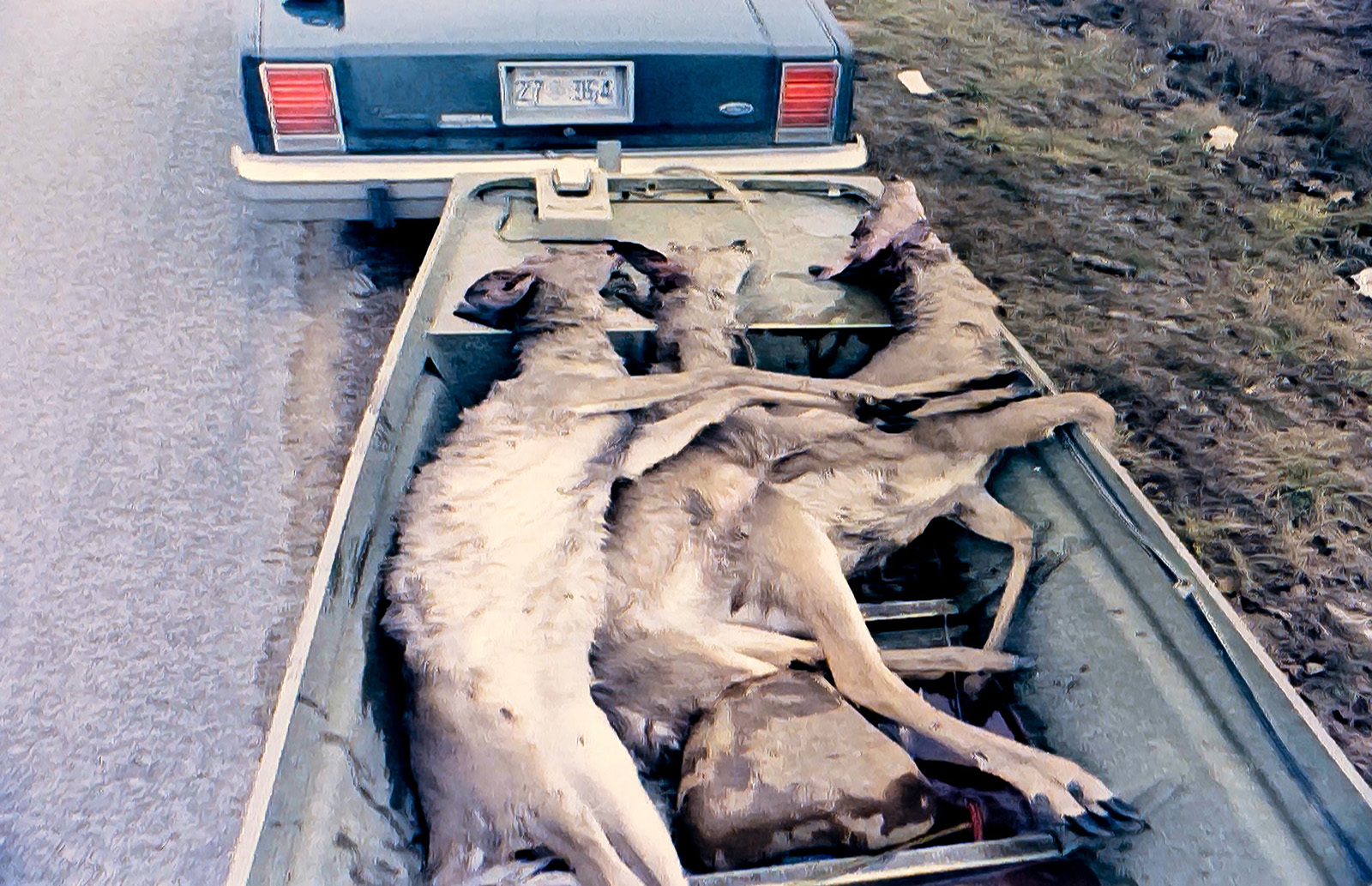
The three deer seized as evidence from the suspects of the Pamunkey River. Also pictured is Warden Perry’s issued jon boat and Ford Crown Victoria. Photo courtesy of Game Warden Rick Perry
In all, Perry had written 15 tickets among the five hunters that day. He obtained summonses for the father and grandfather for shooting deer from a boat but was unable to confiscate the boat, since they had been advised to sell it. In New Kent, they were found guilty and ordered to pay replacement costs of $200 for each deer. The three hunters from the blind were tried as companions and found guilty. One of the three had an outstanding prior and appealed the ruling to prevent losing his hunting license. He requested a jury trial, the first for a game case in New Kent County. Though the appeal was lost, Perry won and was honored for his exemplary service when he received the 1985 Game Warden of the Year award.
Perry, a native of the City of Franklin, started his wildlife law enforcement career as a Virginia Game Warden in 1978. After completing 14 weeks of training, he was assigned a district that comprised Henrico, Chesterfield, Charles City and New Kent counties. As Perry excelled at the job, so did his academic career. Perry would graduate Virginia Commonwealth University with a bachelor’s and master’s degree. In 1985, Perry reached another milestone when he became Virginia’s Game Warden of the year and Southeastern Association of Game and Fish Commissioners officer of the year. In 1987, Perry was hired as a Special Agent with U.S. Fish and Wildlife Service. After retiring in 2009 as Special Agent in Charge, he spends his free time enjoying the outdoors, training his rescue lab, and, more impressively, riding his unicycle.
Master Conservation Police Officer Eric Dotterer grew up in Shelbyville, Tennessee, where his love for hunting and fishing started at a young age. He set a goal of becoming a game warden by age 8 and spent his early years working at a hunting preserve located near his home. In 2007, he graduated from Tennessee Technological University with a degree in Wildlife and Fisheries Management and was hired by Virginia’s Department of Wildlife Resources later that year. After the academy, he was assigned to Pittsylvania County and continues to serve the area.