
Cowpasture River Biologist Report 2025
The Virginia Department of Wildlife Resources (VDWR) began to monitor the fish population in the Cowpasture River in the 1990’s. Prior to that, the Department did not have the proper equipment to adequately assess the river’s fish community. The size and average depth of the river limits reaches that can be sampled with a small electrofishing boat. Historically, VDWR has collected sportfish population data at several locations on the Cowpasture River. Sampling locations from upstream – down to the mouth: Wallace Tract, Riverside, Sycamore Bend, Windy Cove, Nimrod Hall, Walton Tract, Lynchburg Camps, and Griffith. However, sampling effort and consistency has varied over that period. This lack of consistency (year, season, location) has made it difficult to accurately document changes in the sportfish community. The best way to document changes in the fish population is to minimize sampling variability by choosing permanent sampling locations and returning during the same season on an annual or semi-annual basis.
VDWR staff have struggled to find the staff time and river conditions to sample the Cowpasture in recent years. In the fall of 2024, staff decided to return to traditional fall sampling using boat electrofishing gear. Going forward the plan is to sample four sites (Griffith, Lynchburg Camps, Sycamore Bend, and Walton Tract) on a yearly basis during the fall. When viewing the data below, keep in mind that there is a ten-year gap between the 2013 and 2024 sample.
Smallmouth Bass
The Cowpasture River is one of the most scenic rivers within the western part of the Commonwealth. When water levels moderate, anglers can expect to catch a diverse assemblage of fish. During the fall of 2025 biologists sampled four sites collecting 22 species, which included Bass, Sunfish, Suckers, Minnows, Catfish, Darters, Trout, Musky, and Catfish.
The Smallmouth population is struggling, but improving slightly within certain sections. Similar to the James River, it has suffered from poor spawning for a number of years. As a result, very few quality fish (fish > 11”) are present within the system (Figure 1). Of the 180 bass collected 11% of the smallmouth were 11” or greater with 1% exceeding 14”. No bass greater than 15” were captured. Anglers should catch a slightly improved number of fish ranging from 7-10” as a result of the good spawn in 2024. We also observed an improvement in quality fish compared to the 2024 sample. Nothing to get overly excited about, but it is a start. To improve your catch, target only the areas with deep water containing quality structure like sunken logs and boulder outcrops. The Cowpasture desperately needs a few years of above average spawning success. Unfortunately, due to the high flow events in the spring, 2025 was another down year for the spawn. The spawn wasn’t a complete bust, but low numbers of baby smallmouth were collected (Figure 3). The boom year class of 2024 will continue to grow next spring through summer, and if these juveniles survive to adulthood, the fishing should pick up within the next few years. Keep in mind, bass grow slow in the Cowpasture. It takes at least 5 years to grow a fish over 11”, so anglers will have to be patient.
To speed up the recovery, biologists and hatchery staff raised fingerling smallmouth bass at the Front Royal Fish Cultural Station. This effort is part of a long-term smallmouth bass stocking project. Fortunately, the hatchery produced more fish than what was required for the study. A surplus of 21,500 fingerlings were stocked into the Cowpasture as a result. The fish were spread between seven sites from the Walton Tract landing to Evans Tract boat ramp. Hopefully survival of the fingerlings will be high and assist with the recovery of these sections of river. Biologists will replicate this stocking in 2026 if surplus bass are once again produced; and will cease stocking if the population makes a recovery, either through natural spawning or stocking efforts.
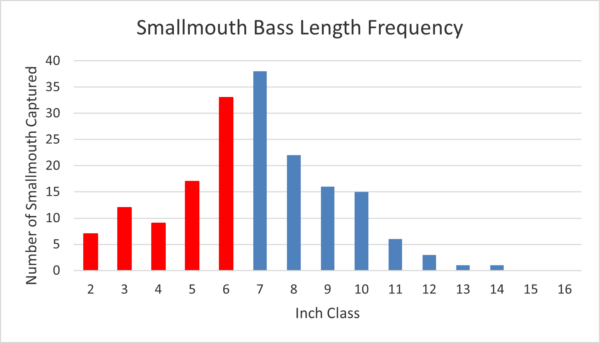
Figure 1: Number and lengths of smallmouth bass collected from the Cowpasture River in fall 2025. Juvenile bass (less then 7 inches) are represented with red bars, while adult smallmouth bass are shown with blue bars.
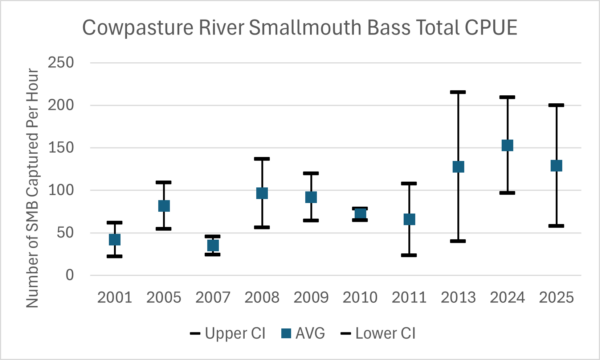
Figure 2: Annual catch of smallmouth bass from 2001 – 2025 in the Cowpasture River.
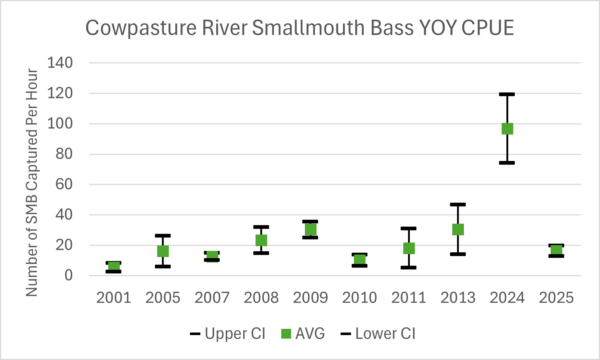
Figure 3: Annual catch of young of year (YOY) 5-6 month old smallmouth bass from 2001 – 2025 in the Cowpasture River.
Sunfish
The Cowpasture is also home to a variety of sunfish including rock bass, redbreast sunfish, green sunfish, pumpkinseed and bluegill. In 2025, a total of 432 sunfish were collected. Redbreast sunfish and Rockbass were the most abundant sunfish collected and ranged from 2 to 8 inches in length. The sunfish will run on the small side with only 11% of the sample exceeding 6” in length. Anglers can expect good catch rates of redbreast and rock bass in 2025 as their population looks stable when compared to previous samples (Figure 4). Although often overlooked, angling for sunfish can provide great entertainment, especially using light tackle or fly-fishing. Angler seeking sunfish should focus on fishing near banks, aquatic vegetation, and fallen trees. Spinners, small grubs, crickets, and worms all make excellent baits for catching sunfish.
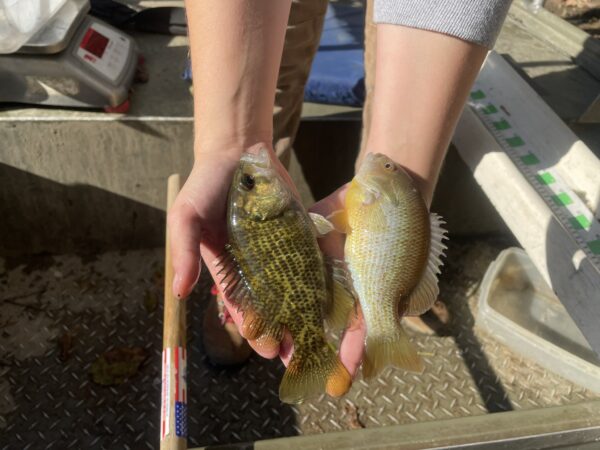
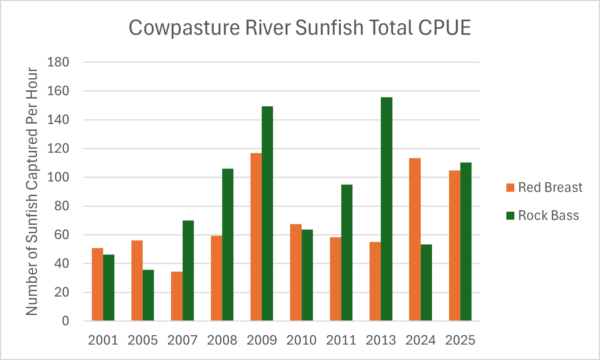
Figure 4: Annual catch of redbreast sunfish and rock bass from 2001 – 2025 in the Cowpasture River.
Muskellunge
The largest and most challenging fish to catch in the Cowpasture is the muskie. Muskies can be found downstream of the dam in Millboro Springs to the mouth of the James within deep slow moving pools. Three muskies, measuring 35-36 inches in length, were collected during fall community sampling in 2025, with a handful of other adults observed. There is a small self-sustaining population of muskie in the Cowpasture, they are not stocked. Anglers should target the months of May and June just after the muskies spawn. Adult muskie from the James have been known to migrate into the Cowpasture in April to reproduce. However, due to habitat limitations, they often migrate back downstream once the spawn is complete. Muskies can be very picky so anglers often use a variety of baits throughout the year including large crankbaits, glide baits, swimbaits, spinnerbaits, and tubes.
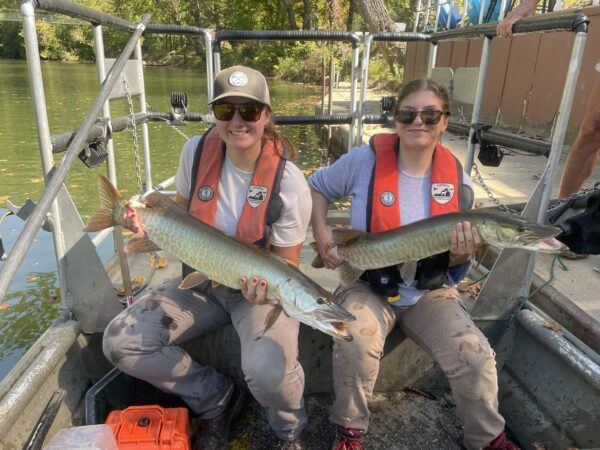
Table 1: Fish species collected by VDWR during fall electrofishing surveys. (n = 22)
____________________________________________________________________________________________
Stripeback Darter Cutlips Minnow Rockbass
Bluegill Sunfish Fallfish Smallmouth Bass
Black Jumprock Green Sunfish White Sucker
Chain Pickerel Margined Madtom Yellow Bullhead Catfish
Bull Chub Muskellunge Largemouth Bass
Creek Chubsucker Northern Hogsucker Rainbow Trout
Central Stoneroller Pumpkinseed Sunfish
Crescent Shiner Redbreast Sunfish
____________________________________________________________________________________________