
North Fork Shenandoah Biologist Report 2025
Smallmouth Bass
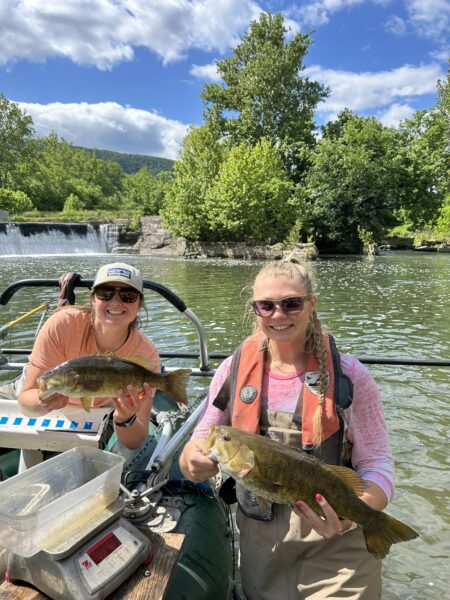
The North Fork Shenandoah is slowly rebounding after a few down years. It may not have the overall numbers of smallmouth that it once did 10 years ago, but a float trip on this river will not disappoint. During our 2025 spring raft sampling we collected 341 Smallmouth Bass at a rate of 59.4 fish per hour within three 6 mile floats located within the upper, middle, and lower sections of the North Fork (Figure 1). Our total catch rate increased slightly compared to our 2024 sample but remains below the long-term average of 66.2 bass per hour. Approximately 50% of the smallmouth were 11” or greater with 27% topping 14”. Seven percent of the sample measured 17” plus. These are very high percentages of angler preferred size classes for the Shenandoah drainage. The number of quality and preferred sized fish continues to increase when compared to previous year’s samples (Figure 2). In fact, the larger size categories (14”+ and 17”+) are at the highest catch rates since we started raft sampling in 2013. These quality bass are only showing up within the lower reaches, below the Woodstock Dam all the way to the confluence with the South Fork Shenandoah. The upper sections of the river are still struggling with overall numbers, especially quality fish. Fortunately, we did capture a fair number of juvenile bass (<7”) within all three sections ranging from 20-30 fish per hour. This is the best catch rate of juvenile fish since 2021 and will help improve the population in the coming years. However, to get the population back to where it was prior to the 2018 flood event, the North Fork will need several good spawns. Unfortunately, the high flows during May and June most likely prevented that from occurring.
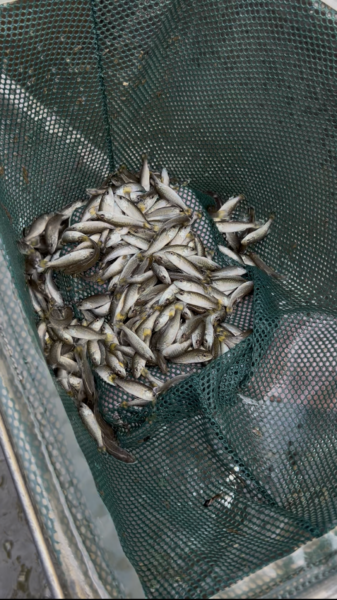
In an effort to speed up the recovery, biologists and hatchery staff raised fingerling smallmouth bass at the Front Royal Fish Cultural Station. This effort is part of a long-term smallmouth bass stocking project. Fortunately, the hatchery produced more fish than what was required for the study. A surplus of 41,694 fingerlings were stocked into the North Fork Shenandoah as a result. This was more than double the number stocked in 2024. The fish were spread out within four sections of the North Fork: New Market to Mount Jackson (16.81km), Seven Bends State Park to Artz Road (17.23km), Helsey Lane to Colby Lane (16km) and Deer Rapids to Long Meadow Road (21km). Hopefully survival of the fingerlings will be high and assist with the recovery of these sections of river. Biologists will replicate this stocking in 2026 if surplus bass are once again produced; and will cease stocking if the population makes a recovery, either through natural spawning or stocking efforts.
As for fishing in 2026, anglers should target the middle and lower reaches of the North Fork within the Woodstock, Edinburg, and Strasburg areas. Biologists observed good numbers of bass and the highest amount of quality fish within these sections.
The North Fork has more than just Smallmouth to offer our avid anglers. Fallfish are plentiful in some sections of the North Fork, can exceed 14 inches, and should not be overlooked. Anglers will also encounter fantastic numbers of Redbreast Sunfish in most areas. Our sample yielded the highest catch rate of all time at 142 sunfish per hour with 11% of the sample containing fish larger than 6” (Figure 3). Rock Bass numbers are low, but they can also be encountered near rocky habitat. Within the deeper pools, the opportunity to catch a quality-sized Largemouth Bass, Channel Catfish, or the occasional Musky is possible. Pool habitat is limited, so seek out deeper water when targeting these species.
VDWR periodically stocks fingerling-size musky on the North Fork Shenandoah River at 11 sites stretching from New Market to Strasburg. It was last stocked in 2025 with 355 fingerling musky (approximately 3-4”). There has been limited evidence of muskies reproducing naturally in the North Fork, therefore they must be stocked to sustain a fishery. Musky are stocked to add diversity to the fishery and provide a challenging trophy fish for anglers to target. Adult musky densities are not as high as some of the other rivers in the state due to the lack of consistent pool habitats. However, when you come across a pool on the North Fork, anglers have a marginal opportunity to encounter one.
If you plan a float trip on the North Fork Shenandoah; stick to spring and early summer, as low flows and dense vegetation can make fishing and navigation difficult later in the year.
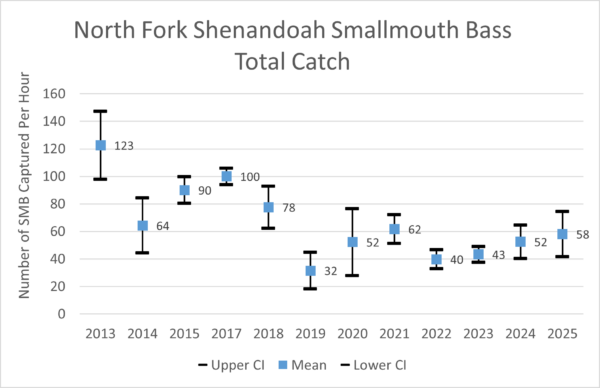
Figure 1
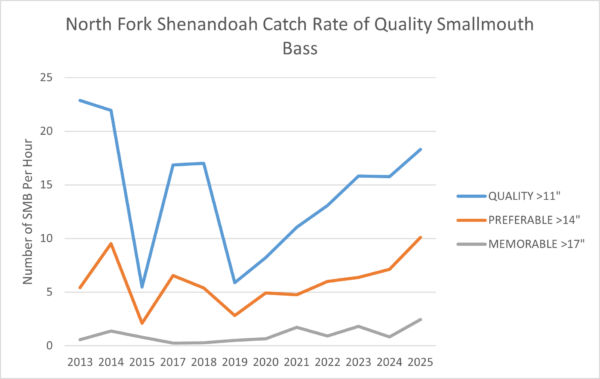
Figure 2
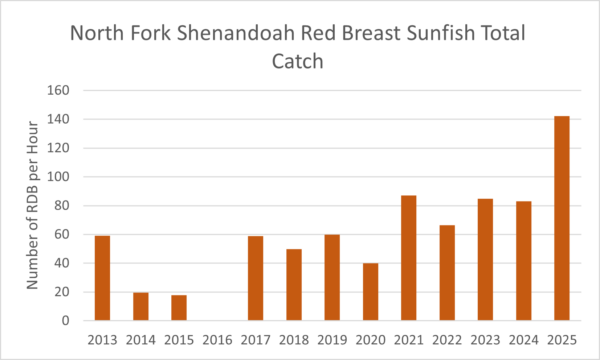
Figure 3