

What’s Happening at the Nest?
In the absence of a fifth egg laying event, this years clutch is now complete with four eggs being incubated near continuously. Incubation also means that Falcon Fans are just about guaranteed to see one of the adults on camera at all times as the eggs are generally not left unattended for extended periods of time during incubation exchanges. Peregrine falcon eggs are incubated for roughly 33-35 days which means we should expect to see our first signs of hatching around April 25th-April 27th.
Both the male and the female take shifts incubating and thus have developed paired brood patches (featherless patches of skin on the bird’s breast which aid in incubation). By selectively losing these feathers, more direct contact area is created with the skin of the adult bird’s breast and thus the numerous warm blood vessels which are used to maintain the eggs temperature. Although the brood patches are obscured by an outer layer of feathers and therefore not visible to Cam watchers, you may observe the incubating bird shifting its position or shimmying atop the eggs. These movements allow the bird to better position the eggs to ensure maximum contact with their brood patches.
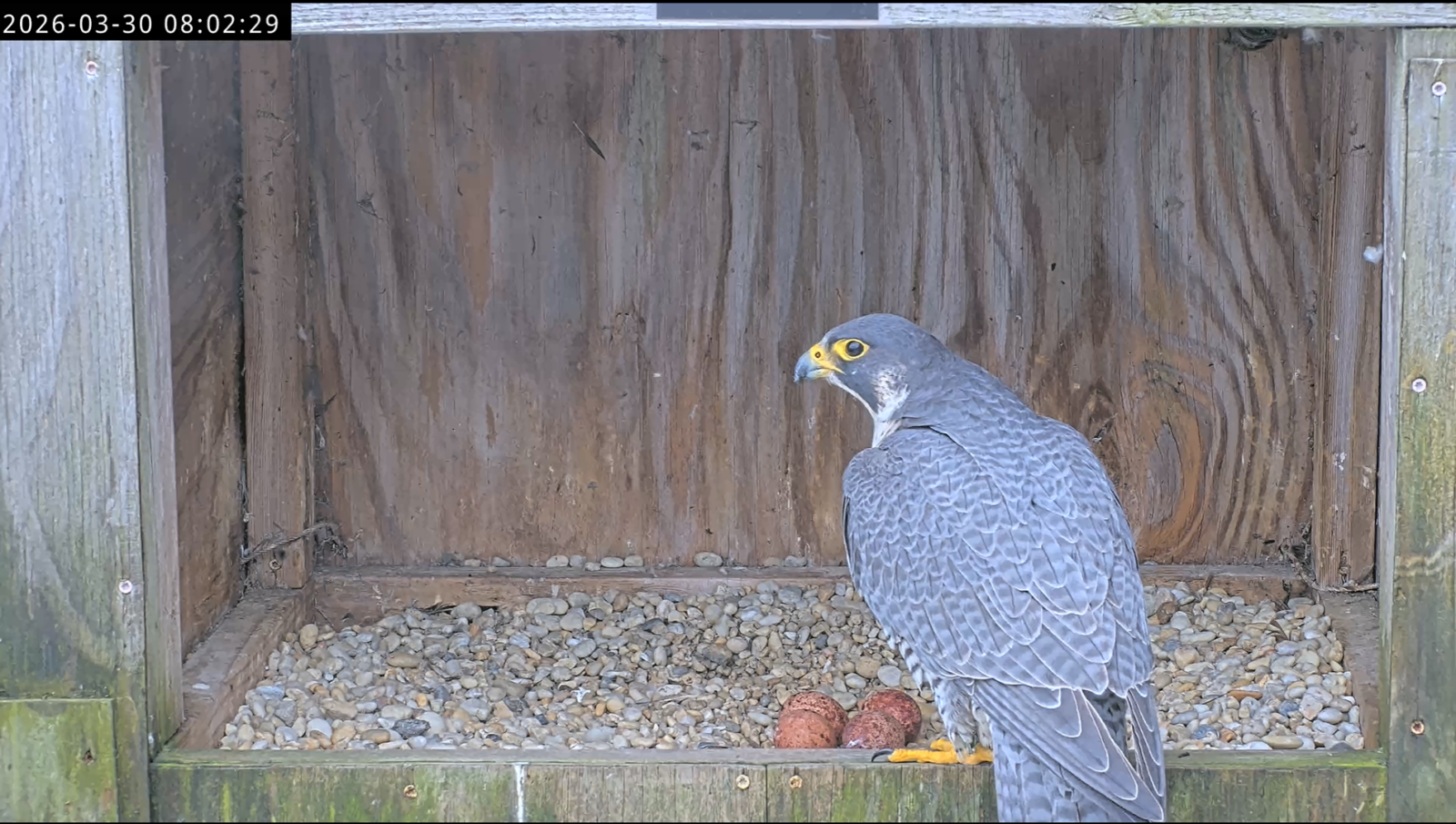
The female falcon (95/AK) pauses on the lip of the nest box before she continues to incubate her clutch of four eggs.
Egg laying is underway with the fourth egg of the year having being laid at 9:17 AM on the morning of March 26th. Peregrine falcon eggs can range in color from a creamy white or pale pink to a deep reddish-brown and are often mottled with darker brown or red blotches. Normally, the more recently laid eggs will have a brighter appearance relative to older eggs. Can you spot the new egg in the nest box?
Peregrine Falcon clutches average 3-4 eggs in size, but five-egg clutches are laid occasionally. Falcon eggs are typically laid in intervals of 48 to 72 hours so pay close attention to the Falcon Cam on Saturday (3/28) to see if a fifth egg is laid. We will be providing all egg laying updates as the occur, so be sure to check back regularly!
2026 Egg Laying Dates:
First Egg: 3/19 between 6-7 AM
Second Egg: 3/21 Approximately 1:58 PM
Third Egg: 3/23 at 10:45 PM
Fourth Egg: 3/26 at 9:17 AM
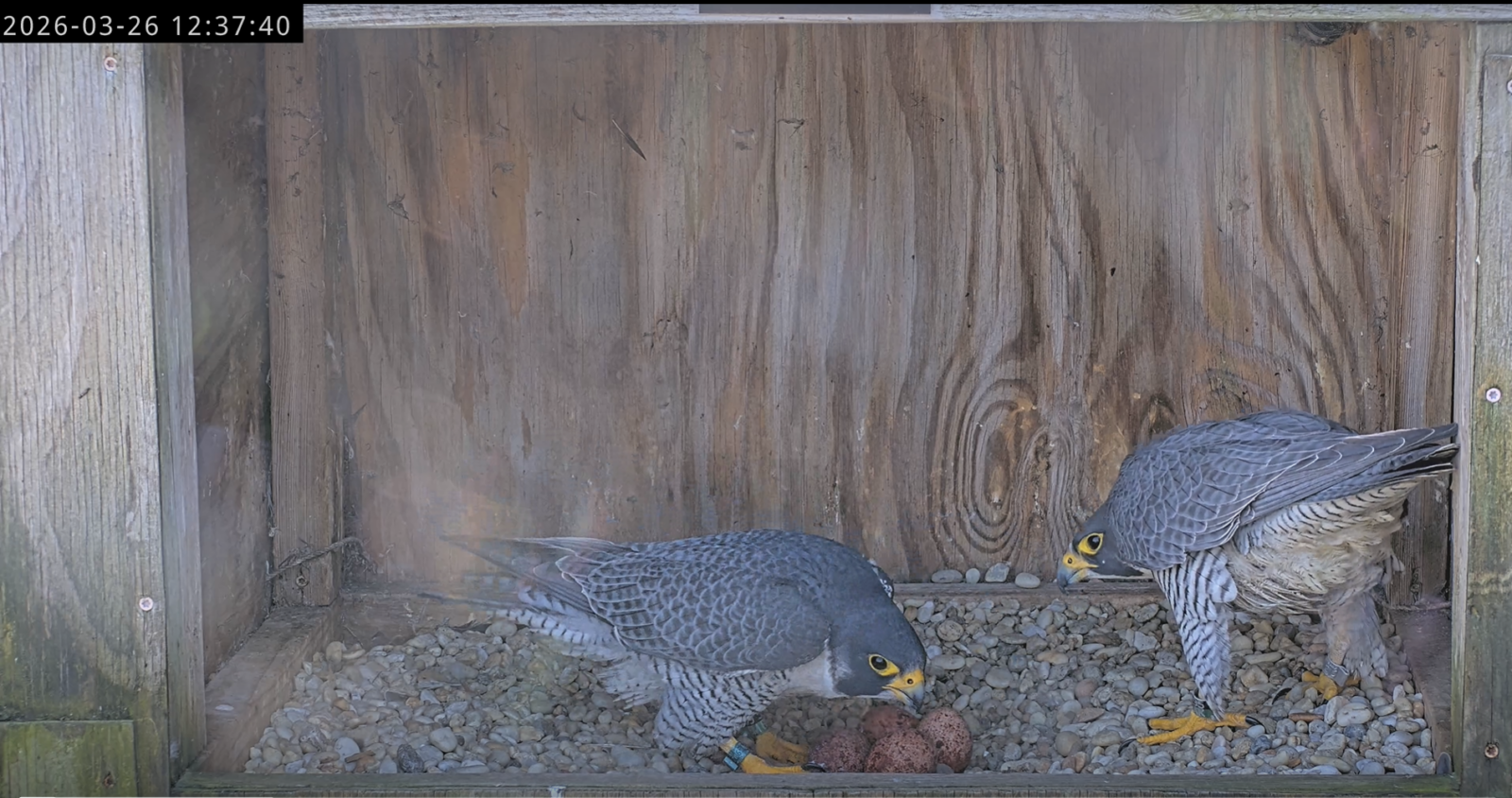
The falcon nest downtown now has four eggs! The male (left) and female (right) share incubation duties, regularly taking turns on top of the eggs. Here, the male prepares to leave, while the female waits for him to get up so she can replace him.
The Falcon Cam is back online following a brief period of downtime due to necessary building maintenance in the area. We are continuing to see quite a bit of both birds on camera with 95/AK (the female), often roosting on camera at night. Based on all the activity we’ve been seeing as well as 95/AK’s history of when her first egg of the season has been laid in past years, we suspect that an egg may be laid within the next week or so. Both last year and the year prior, her first egg has been laid in the morning hours of March 18th — so keep watch and we will see if that pattern will hold true for another year!

The female, 95/AK perches on the parapet wall while her mate, 59/BM rests on the lip of the nest box. Both birds have been spending multiple hours on camera every day.
- Read more updates in the archive…


Internet service to the Falcon Cam provided courtesy of Comcast Business.
The DWR Falcon Cam follows the breeding season of a peregrine falcon pair that nests in downtown Richmond, Virginia. The nest box is located atop the Riverfront Plaza building. If you’re in the area, look up! You may catch a glimpse of the famous birds! We hope each year that the pair will once again choose to nest at this site, so that our camera may provide an educational experience for all to enjoy.