
The Richmond Falcon Cam live stream is scheduled to return in March 2027. Please check back and sign up below to receive the latest updates directly in your inbox! In the meantime, please enjoy this video of the banding of the 2021 Richmond peregrine falcon chicks.
What’s Happening at the Nest?
The Falcon Cam livestream will be turned off on Friday, June 26th now that the season has concluded. This was an especially tough year for the birds, for viewers and our DWR team and we want to extend our thanks for following along throughout the ups and downs of this season. We are also grateful to the property managers who graciously granted us access to their buildings, which gave us a much-needed bird’s-eye view of the downtown Richmond landscape and the numerous staff and volunteers who helped with our monitoring. We would also thank our partners at Comcast for their sponsorship and all of our viewers for diligently tuning in throughout the season.
If we receive any significant updates on Plum or either of the adults during the off season we will post them here. As she continues to mature, she will begin making larger movements and spend less time in the downtown area. We wish her well wherever her wings end up taking her and look forward to seeing you next year for another season of Falcon Cam.
We just learned today that Black has fallen victim to a fatal collision with a building in downtown Richmond. Black was found at 1 pm on Monday, June 15, on a terrace on the northeast side of the CoStar building. This is a new building with a glass façade that is just wrapping up construction. The building is found to the west of the Federal Reserve. As we are unaware of anyone having witnessed the collision, we do not know the exact circumstances surrounding the event. Words cannot properly express how we are feeling about the unprecedented loss of three of this year’s four fledglings.
We’re disheartened to report that on Friday (6/12) while tracking the fledglings and adults downtown, another fledgling was observed colliding with a building. During monitoring efforts, one of our team members witnessed an aerial prey exchange between an adult and a juvenile. Following this event, the juvenile circled back towards the Bank of America building which it hit, dying immediately on impact. Staff arrived within minutes of the collision, and the bird was identified as White.
This loss is deeply saddening for our team who have collectively spent hundreds of hours monitoring these birds from hatch through fledge. The events of this year serve as a sobering reminder of the challenges urban wildlife face and highlight the ongoing need to create safer urban landscapes for wildlife. This is especially important given that peregrines across the globe are drawn to nesting in urban areas. New York City for example boasts one of the largest breeding concentrations of peregrine falcons in the world. Urban areas are especially attractive to the species as they offer plentiful prey bases, clear sightlines for hunting, and fewer predators. Though cities like Richmond offer several advantages which attract the birds, a tradeoff is that they also expose both adults and young to mortality through collisions with buildings.
Both Black and Plum are known to still be active, with volunteers reporting four falcons simultaneously in view today (6/15) dispersed between the south-facing TowneBank sign, the west-facing and south-facing Truist signs, and the northeast corner of the Federal Reserve building. We expect both Black and Plum to continue interacting with their parents over the next several weeks as they hone their flying skills and learn to hunt prior to setting out on their own.
Although the outcome of this year isn’t what any of us had hoped for, we feel it is important to highlight the broader success of the Richmond nesting peregrines. Since 2003, 53 chicks have successfully fledged from this site, and eight building-collision fatalities have been documented among those birds. Numerous Richmond offspring have gone on to contribute to the greater peregrine population, helping to ensure the continued recovery and growth of the species. Notably, Red, a 2021 fledgling, established a breeding territory in Norfolk in 2022, where he and his mate, 32/BH, have successfully raised chicks every year since. Another 2021 fledgling, Orange, is strongly suspected, based on a partial band read, to have nested in the mountains last year. Given the limited number of breeding pairs in the western portion of the state, this was an especially notable discovery.
While losses such as White’s and Yellow’s are difficult, these stories serve as a reminder that the majority of fledglings leave downtown to begin lives of their own, hopefully going on to contribute to the next generation of peregrines across the region.
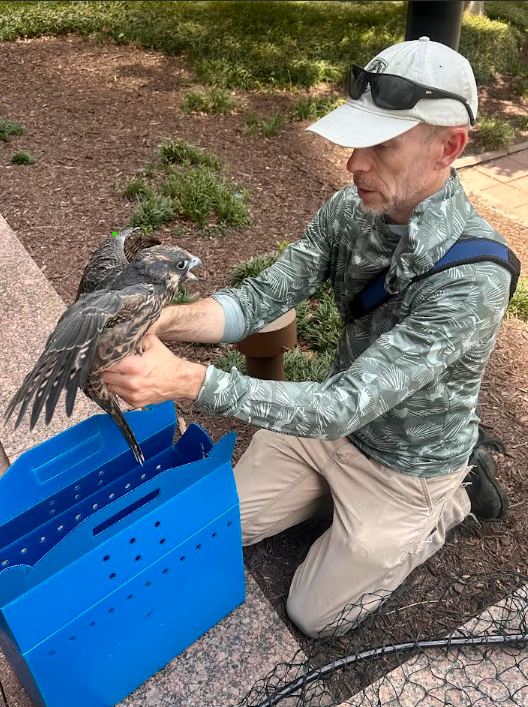
DWR staff evaluated Plum on 6/10 after she was grounded. Ultimately she was deemed uninjured and returned to the ledge.
- Read more updates in the archive…


Internet service to the Falcon Cam provided courtesy of Comcast Business.
The DWR Falcon Cam follows the breeding season of a peregrine falcon pair that nests in downtown Richmond, Virginia. The nest box is located atop the Riverfront Plaza building. If you’re in the area, look up! You may catch a glimpse of the famous birds! We hope each year that the pair will once again choose to nest at this site, so that our camera may provide an educational experience for all to enjoy.