
Description
Back Bay National Wildlife Refuge (NWR) contains over 9,200 acres of marsh, beaches, dunes, woodlands and farm fields. The southern part of the refuge includes an extensive impoundment complex. These managed water pools are visible to visitors as they travel refuge trails on the way to adjacent False Cape State Park, which is only accessible by foot, bicycle, boat/kayak or tram. Boardwalk trails traverse portions of the freshwater marsh, and in summer a combination of woodland and estuarine birds are found here. A canoe/kayak launch is available for those wishing to explore the NWR from the water.
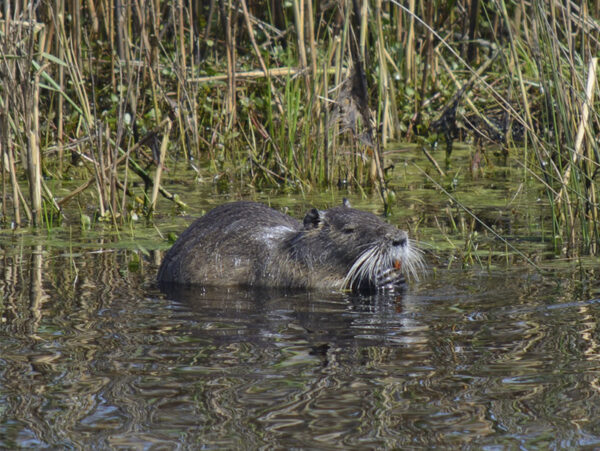
Nutria (Myocastor coypus), an invasive species from South America, are common in Back Bay NWR. Photo Credit: Lisa Mease/DWR
The Refuge focuses on providing habitat for water birds, with an emphasis on waterfowl, shorebirds, and threatened species. It is a hotbed of activity for birders with nearly 300 recorded species. During the peak of winter migration a wide variety of ducks, tundra swans and snow geese visit the Back Bay. Other winter migrants include the rare LeConte’s sparrow and ubiquitous yellow-rumped warbler. Spring migration brings songbirds and shorebirds that fill the wetlands, shrubs, and woodland areas. Mammals, such as river otters, white-tailed deer, raccoons, and bobcats also reside in the Refuge. Numerous reptiles and amphibians rely on the habitats of Back Bay NWR, including cottonmouths (water moccasins), which are seen frequently.
Hours
The refuge is open daily, ½ hour before sunrise to ½ hour after sunset.
Fee: $5.00 April 1 -October 31, Free November 1 – March 31. (Portions of the refuge are closed during the winter migration; as such there is no fee during this period.)
Visitor Contact Station hours: 8am-4pm weekdays and 9am-4pm weekends; closed Sundays November 1 – March 31 and Mondays all year. Closed holidays except Memorial Day, July 4, and Labor Day.
Wildlife Sightings

339 species have been reported at this site to date.
Birds Recently Seen at Back Bay National Wildlife Refuge:
- Ring-billed Gull
- Double-crested Cormorant
- Turkey Vulture
- Osprey
- European Starling
- Eastern Bluebird
- Red-winged Blackbird
- Common Grackle
- Northern Shoveler
- Mallard
Recent Checklists:
| Date | # of Species | Submitted By |
|---|---|---|
| 28 Mar 2026 | 8 | Cory Davis |
| 27 Mar 2026 | 53 | Rob Bielawski |
| 25 Mar 2026 | 46 | Robert Ake |
| 25 Mar 2026 | 46 | Reuben Rohn |
| 25 Mar 2026 | 46 | Elena Bersani |
Amenities & Accessibility
Amenities
- On-site Parking
- Restrooms
- Kayak/Canoe Launch
Other Amenities: Bike Trails, Hiking Trails, Viewing Blinds, Visitor/Nature Center
Accessibility Considerations

This location does not have a Birdability Site Review available at this time
Learn more about Birdability’s efforts to map accessible outdoor spaces
Maps & Directions
Physical Address: 4005 Sandpiper Road, Virginia Beach, VA 23456
From I-64, exit to I-264 East (towards the Oceanfront). Take Birdneck Rd Exit (Exit 22). Turn right onto Birdneck Rd and travel 3-4 miles. Turn right onto General Booth Blvd and travel approximately 5 miles. Turn left onto Princess Anne Rd. At the next traffic light, proceed straight, continuing on Princess Anne Rd, which changes names to Sandbridge Rd. Follow Sandbridge Rd into the Community of Sandbridge. Make a right turn onto Sandpiper Rd, just past the Fire Station. Travel 4 miles, until Sandpiper Rd ends. The entrance to Back Bay NWR is on the left.
Site Information
Access Requirements:
- See site description.
Contact Information:
- (757) 301-7329
- Visit Website
Sites, or portions of sites, can be closed periodically for management activities. Please always check the site’s website for additional information prior to visiting.