
Description
Elevation: 580 ft.
The Blandy Experimental Farm is a field station operated by the University of Virginia. Its 700 acres are a good representation of the habitats found in the Shenandoah Valley, making it an excellent spot to watch birds and other wildlife. The Orland E. White Arboretum sits at the center of the property, providing an excellent opportunity for visitors to familiarize themselves with the local flora. The 2.6-mile Wilkins Lane Loop Drive allows visitors to see some of the more remote areas of the Arboretum. The Virginia Native Plant Trail is not to be missed during spring and early summer when the wildflowers are vibrantly in bloom. The Pollination Garden and numerous wildflowers elsewhere on the property attract a high diversity of butterflies, while the various ponds and marshes attract a variety of dragon- and damselflies.
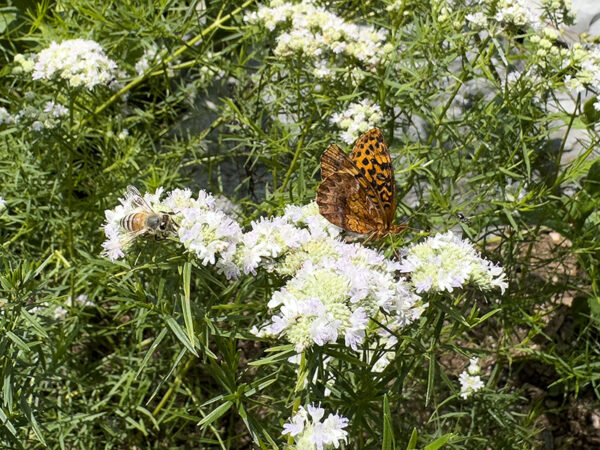
A honey bee and meadow fritillary enjoy the narrowleaf mountain mint along the Virginia Native Plant Trail. Photo Credit: Lisa Mease/DWR
Birds to search for in the woods and meadows of the farm include red-tailed hawk and American kestrel as they patrol the open fields and Cooper’s hawk darting through the woods. Woodpeckers on the farm include red-headed, red-bellied, downy and pileated, as well as northern flicker. The farm’s extensive undisturbed meadowlands provide nesting habitat for several species are declining or have disappeared elsewhere in Virginia. These species include northern bobwhite, willow flycatchers, and grasshopper sparrows. Blandy is an excellent spot for migrating warblers in the spring and fall. Winter is the best time to search for American tree, white-crowned, and swamp sparrows, and even loggerhead shrike and short-eared owl show up occasionally.
Wildlife Sightings

229 species have been reported at this site to date.
Birds Recently Seen at Blandy Experimental Farm and State Arboretum of Virginia:
- Chimney Swift
- Red-shouldered Hawk
- Downy Woodpecker
- American Crow
- Carolina Chickadee
- Tufted Titmouse
- White-breasted Nuthatch
- Eastern Bluebird
- American Robin
- House Finch
Recent Checklists:
| Date | # of Species | Submitted By |
|---|---|---|
| 1 Oct 2026 | 25 | Modesto Santiago |
| 1 Oct 2026 | 5 | Jake Tru |
| 30 Sep 2026 | 29 | Dennis Utterback |
| 28 Sep 2026 | 39 | David Carr |
| 27 Sep 2026 | 23 | Dennis Utterback |
Amenities & Accessibility
Amenities
- On-site Parking
- Restrooms
Other Amenities: Hiking Trails, Interpretive Program/Events, Observation Tower/Platform, Viewing Blinds, Wildlife Viewing by Car
Accessibility Considerations

This location does not have a Birdability Site Review available at this time
Learn more about Birdability’s efforts to map accessible outdoor spaces
Maps & Directions
Physical Address: 400 Blandy Farm Lane, Boyce, VA 22620 (The main entrance is located on Route 50/17.)
From Washington – Take I-66 West to Rt. 17 North (Exit 23, sign says Delaplane/Paris). Follow Route 17 North to its junction with Route 50 West at a traffic light. Turn left onto Route 50/17, the Arboretum is approximately 7 miles on the left, about 3 miles past the Shenandoah River.
From Leesburg – Take Route 7 West to Route 340 South at Berryville. Follow Route 340 and turn left onto Route 50 East at a traffic light. The Arboretum is approximately 1.5 miles on the right.
From Winchester – Take Route 50 East (Exit 313 from I-81), the Arboretum is approximately 10 miles on the right, about 1.5 miles past the intersection of Route 50 and Route 340.
Site Information
Access Requirements:
- Daily, sunrise-sunset; admission free
Contact Information:
- Blandy Experimental Farm/State Arboretum: (540) 837-1758 x35, blandy@virginia.edu
- Visit Website
Sites, or portions of sites, can be closed periodically for management activities. Please always check the site’s website for additional information prior to visiting.