
Description
Elevation: 973 ft.
The National Monument is maintained as a historical example of a tobacco farm with numerous historical buildings and artifacts supported by an integrated interpretive program to explain their uses. These facilities provide easy access to fields and woodland and their associated wildlife. Birds to be seen in the area include wild turkey, mourning dove, red-bellied and downy woodpeckers, northern flicker, eastern wood-pewee, eastern phoebe, eastern bluebird, gray catbird, brown thrasher, cedar waxwing, white-eyed and red-eyed vireos, indigo bunting, chipping and song sparrows, and eastern meadowlark. Less common species occurring in the area include prairie warbler, blue grosbeak and orchard oriole, while during migration a variety of warblers, vireos and tanagers could occur. The numerous plantings around the historical buildings attract a variety of butterflies including numerous swallowtails, pearl crescent and a multitude of skippers. The small stream that passes through the property is good for damselflies such as ebony jewelwing.
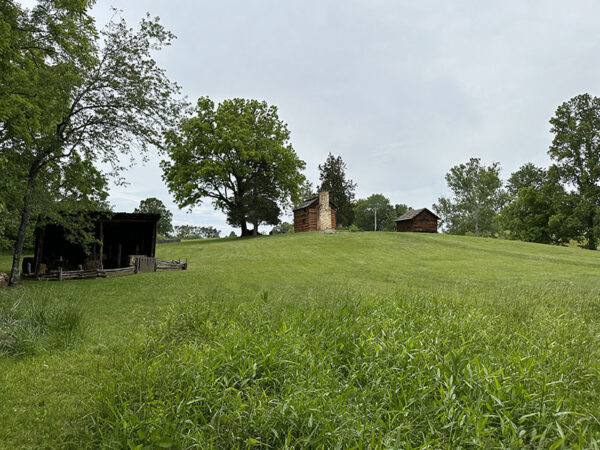
Eastern bluebirds, chipping sparrows, and swallows are just a few of the species on the farm. Photo Credit: Lisa Mease/DWR
Historical Notes:
Booker T. Washington was born a slave on this tobacco farm, generously referred to on occasion as a plantation. He lived here until he was nine years old when he was freed and moved with his mother to be with his stepfather in West Virginia. He later went on to become a great, early civil rights leader who stressed the importance of education. He is also responsible for the founding of the prestigious Tuskegee Institute in Tuskegee, Alabama.
Wildlife Sightings

136 species have been reported at this site to date.
Birds Recently Seen at Booker T. Washington National Monument:
- Yellow-billed Cuckoo
- Black Vulture
- Red-bellied Woodpecker
- Downy Woodpecker
- Hairy Woodpecker
- Northern Flicker
- Eastern Phoebe
- Blue Jay
- American Crow
- Carolina Chickadee
Recent Checklists:
| Date | # of Species | Submitted By |
|---|---|---|
| 30 Sep 2026 | 17 | Ken Washburn |
| 19 Sep 2026 | 20 | Anonymous eBirder |
| 15 Aug 2026 | 16 | Jeff Reid |
| 20 Jul 2026 | 22 | Donald Alexander |
| 20 Jul 2026 | 22 | Suz Frost |
Amenities & Accessibility
Amenities
- On-site Parking
- Restrooms
Other Amenities: Hiking Trails, Visitor/Nature Center, Historical Site
Accessibility Considerations

This location does not have a Birdability Site Review available at this time
Learn more about Birdability’s efforts to map accessible outdoor spaces
Maps & Directions
Physical Address: 12130 Booker T. Washington Highway, Hardy, VA 24101
From Roanoke, head south VA-116 South/Riverland Rd./Mt. Pleasant Blvd. for approximately 13.4 miles, turn left onto VA-122/Booker T. Washington Hwy., at the traffic circle take the first exit onto VA-122 South, and the entrance to the parking area is on the right in approximately 1 mile.
Site Information
Managed By:
- National Park Service
Access Requirements:
- Free, Daily 9am - 5pm
Contact Information:
- 540-721-2094, rebecca_harriett@nps.gov
- Visit Website
Sites, or portions of sites, can be closed periodically for management activities. Please always check the site’s website for additional information prior to visiting.