

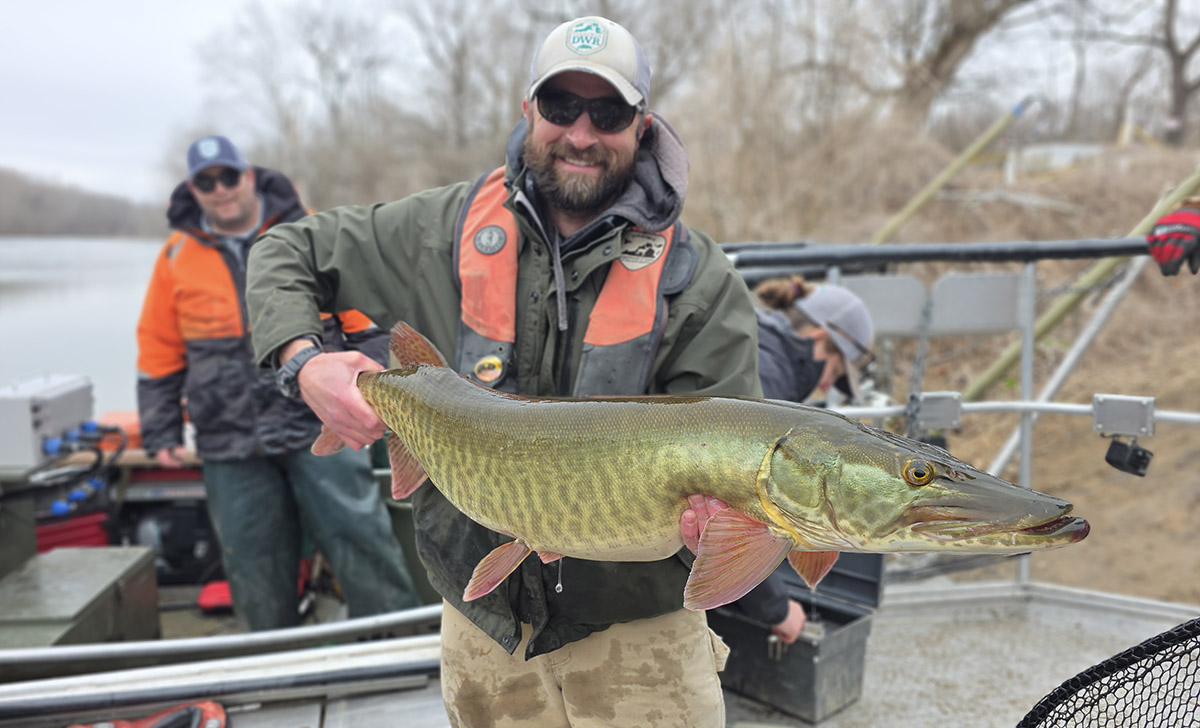
Fisheries Biologist Jason Hallacher displays a beautiful Musky that was collected during a river population survey.
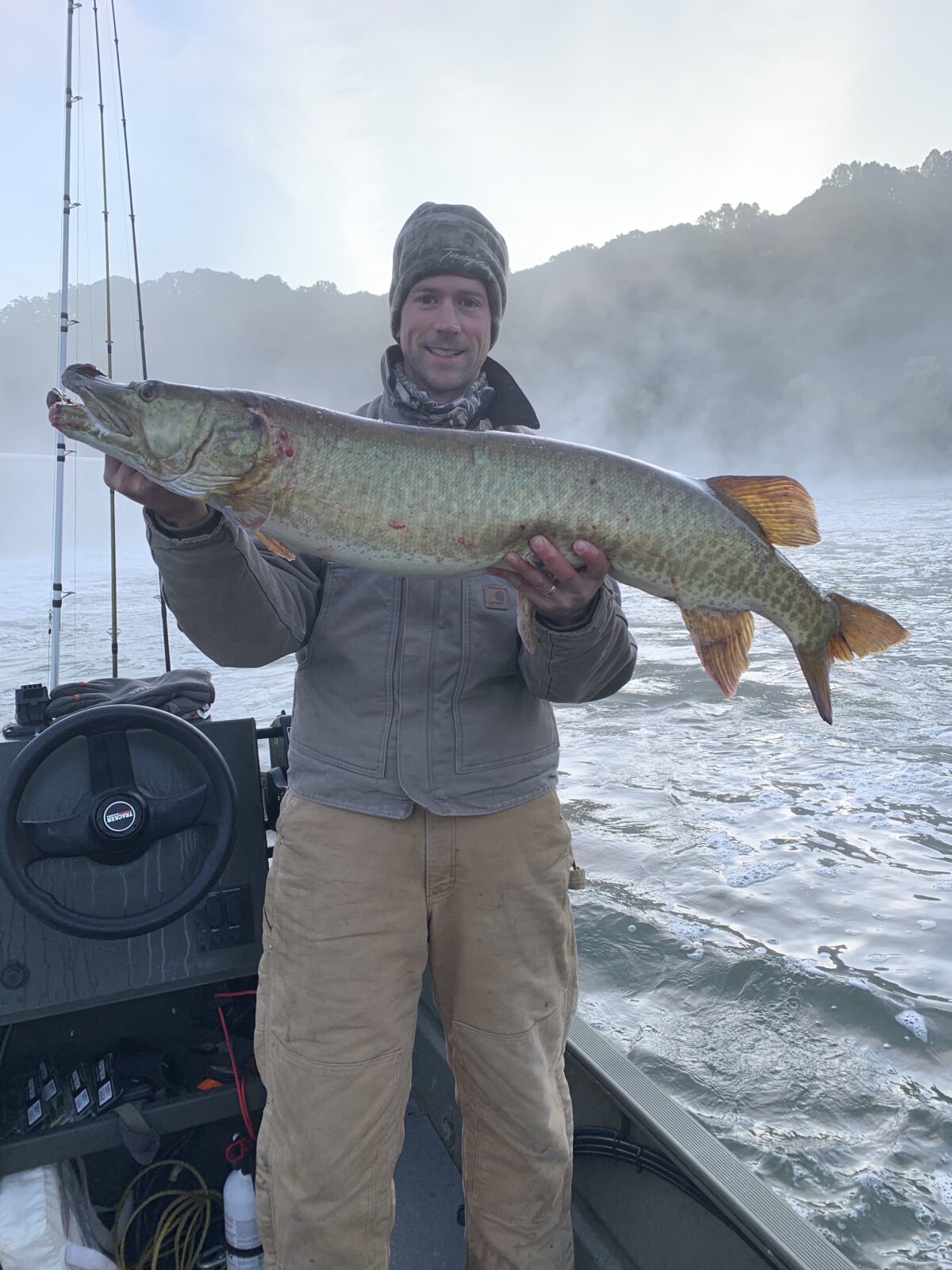
Fisheries Biologist Tyler Young with a sizeable Musky caught while angling. ©Photo by Meghan Marchetti - DWR
Fact File
Scientific Name: Esox masquinongy
Classification: Fish, Order Esociformes, Family Esocidae
Size: Muskellunge "Musky" in Virginia can exceed 50 inches in length
Life Span: About 25 years
Distribution
Muskellunge, more commonly referred to as Musky, have been introduced into several of Virginia’s waters due to their popularity as a sportfish among anglers. They can be targeted in portions of the James River, New River, Shenandoah River, and Upper Tennessee River basin. Use the interactive map below to view waterbody-specific regulations or view fish length data from recent DWR fisheries surveys where available.
Identifying Characteristics
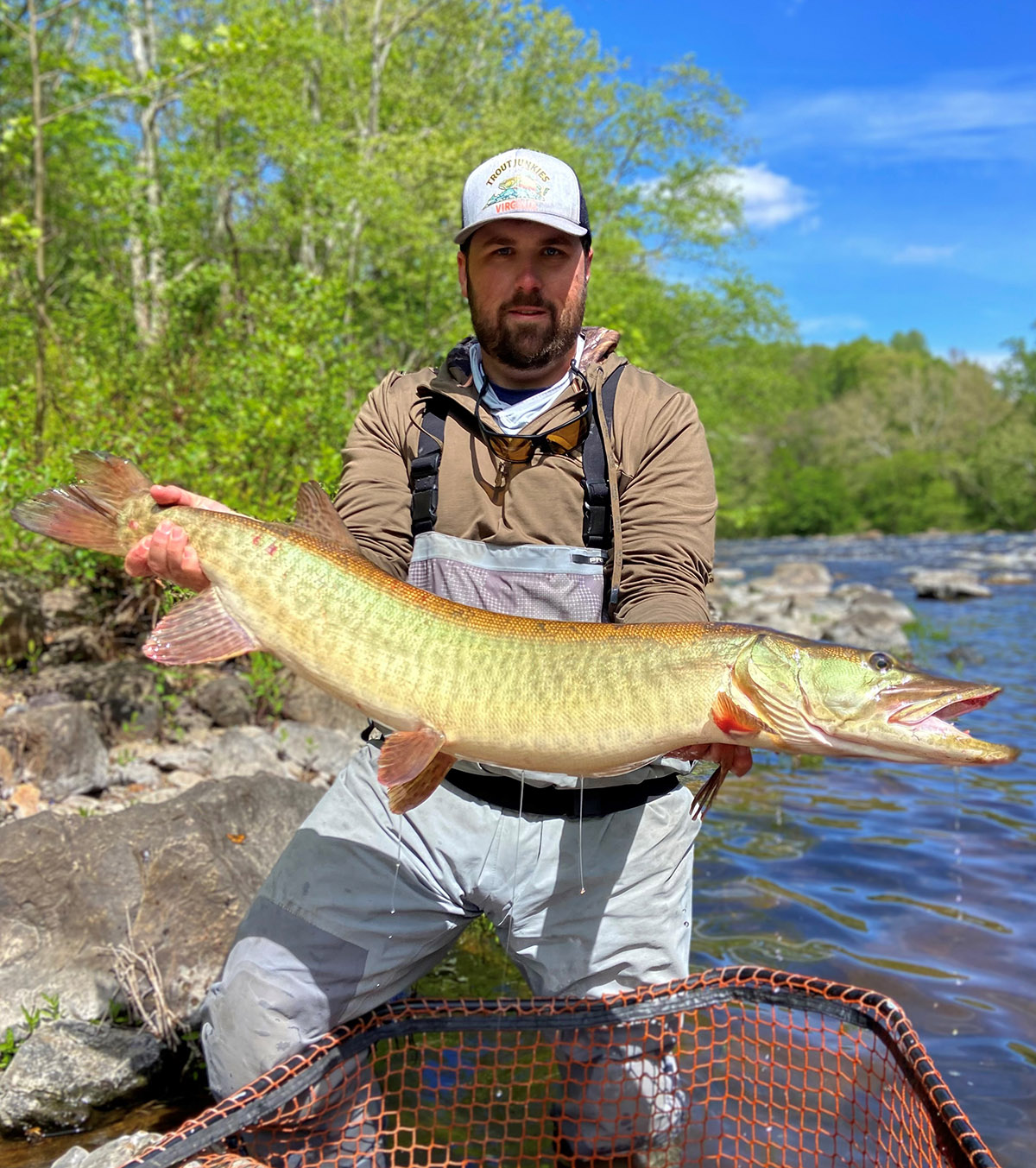
Virginia angler and guide Eric Harvey takes a quick picture before releasing a large Musky. Photo by ©Eric Harvey
- Very elongate body shape, with the dorsal fin positioned close to the caudal fin (tail)
- Normally olive to dark gray on its back, with grayish to bluish to yellowish sides
- A long, duck-like mouth
- Sides may have faint vertical bars, spots or blotches
- Muskellunge (Esox masquinongy) are the largest member of the pike family
Habitat
Musky prefer cool, clear waters with abundant vegetation in lakes, or long pool areas of rivers near fallen trees and other submerged structure. They prefer water temperatures ranging from 62°F – 75°F. Water temperatures up to 89°F can be stressfully tolerated, but Musky stop feeding at 84°F. During the summer Musky can be found seeking refuge where the water is cooler. When this behavior is observed it is recommended to avoid targeting these fish, as they are stressed due to warming water temperatures.
Diet
Musky are an incredibly carnivorous species. Like most fish species, early life stages consume plankton, insects, and other small fish. As they grow, they will opportunistically feed on other animals, and have been observed consuming small mammals, amphibians, and even waterfowl.
Reproduction
In Virginia, Muskies spawn in early spring at the end of March through April when waters reach 50°F – 60°F. Sexual maturity is reached at 3–5 years of age. Eggs are fertilized by 1–3 males and broadcast over aquatic vegetation, leaf mats or gravel bottoms in shallow bays and coves of lakes, or in slack pools or backwaters above or below riffles in rivers. Females release 10,000 to 250,000 eggs depending on size. Most Musky populations in reservoirs are maintained through stocking. Some rivers like the James River and the New River are maintained through natural reproduction.
Musky Management in Virginia
Muskellunge are not native to Virginia. The first stocking of “Musky” occurred within the New River watershed in 1963. These fish were imported from nearby states such as New York, Pennsylvania, Tennessee, and West Virginia. As the project advanced, Virginia DWR staff shifted to collecting brood fish (adult fish that are used to supply eggs and milt) from in-state sources, harvesting their eggs, and raising Musky to various sizes to optimize stocking output. For more information on stocking, click on
Warmwater Fish Stocking Records
scroll to the bottom of the page and select “Historical Stocking Data”.
Tap Here To Continue Reading
Hatchery operations for Musky are weather dependent, but typically happen each year in March and April. Biologists and hatchery staff work together in collecting both male and female Musky from the James River. These brood fish are shipped to the Vic Thomas hatchery where individuals are held for three days and checked for ripeness. A typical female Musky can produce 150,000 to 200,000 eggs, which are then harvested, fertilized by male broodstock, and shipped to the Buller Fish Hatchery. At this point, the brood fish are safely returned to the river from which they were collected.
Aquaculturists at the Buller Fish Hatchery monitor the eggs closely until they hatch. Once hatched, the Musky are stocked into rearing ponds at the Buller and Front Royal Fish Hatcheries. At this life stage, fish are called “fry”, and they feed on plankton, insects, and eventually small minnows. Hatchery staff continue to monitor the ponds throughout the summer until the fish grow into the “advanced fingerling” life stage, which is about 8 to 12 inches in length. In the fall, the rearing ponds are drained and the musky are collected, loaded onto stocking trucks, and distributed to select resources.
While this species is exceptionally difficult and costly to raise, this process has been optimized by DWR staff and has resulted in a massive increase to the survivability of Musky that can’t be achieved under natural ecological conditions.
Since the initial introductions, more waterbodies have been added to the list of stocked waters, and many opportunities now exist as stocked and/or self-sustaining populations across The Commonwealth.
Musky Research in Virginia
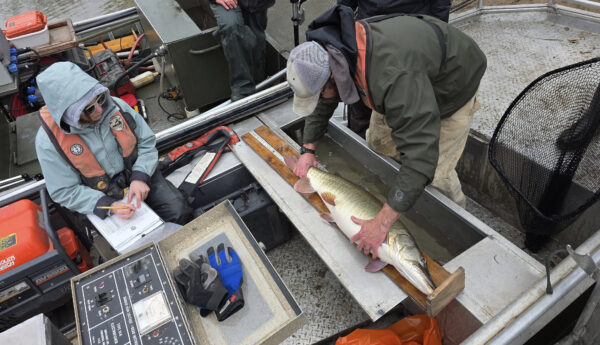
A team of DWR biologists collect important fish data to assess the health of the Musky fishery.
Spring electrofishing and trap netting surveys are conducted on an annual or biannual basis. Trap nets are used to sample reservoirs in late March through early April, while electrofishing boats are used in January or February to sample river populations. All fish collected are measured to the nearest millimeter, weighed in grams, and released unharmed. Biologists will also periodically tag fish to measure harvest, growth, and movement.
James River Exploitation Study
Tap Here To Continue Reading
Over the last 20 years Musky fishing on the James River has grown in popularity. While biologists are monitoring the Musky population with annual electrofishing surveys, little data was available for how Musky anglers use this fishery. Evaluating exploitation allows biologists to better understand how a fishery is being used and helps address questions such as:
- Are anglers specifically targeting these fish?
- How many fish are being caught?
- Are anglers harvesting fish?
To answer these questions, DWR biologists tagged 1,006 muskies in upper James River with yellow tags as part of an exploitation study from 2016 to 2019. The river was broken into two parts, an “upper” section (from the headwaters down to the confluence of the Maury River), and a “lower” section (from the confluence of the Maury River down through Lynchburg).
Biologists determined the exploitation within the upper section to be 57%, while the lower section had 100% exploitation. Put plainly, about half of the Musky in the upper section, and all of the Musky in the lower section are caught at least once on an annual basis.
Of the anglers who caught Musky, the study found that 88% of anglers were targeting muskies when the fish was caught. Only four fish, or about 1% of those caught, were reported as being harvested by anglers over the four-year study period.
These results indicate the James River has a heavily exploited catch-and-release Musky fishery. Musky are a long-lived species, capable of being caught repeatedly during their lifetime if treated responsibly. Anglers are encouraged to use the proper equipment and best handling techniques when Musky fishing. The high rates of exploitation support the need for annual monitoring, ongoing angler education, and underscores the need for supplemental stocking.
Warm Water Catch-and-Release Mortality
Tap Here To Continue Reading
Building off of the findings in the exploitation study, biologists were left wondering if the extreme levels of catch-and-release would affect the ability to sustain high catch-rates or the potential for fish to grow to trophy sizes in the studied locations. Musky anglers also voiced concerns related to the effects of angling during the summer months.
Virginia DWR partnered with Coastal Carolina University to help answer these questions and determine a path forward. To accomplish this, adult Musky in the James River were implanted with radio transmitters after being caught with rod and reel. Tagged individuals were tracked throughout the study period to determine post-release survival.
In the winters of 2020 and 2021, a total of seventy-five Musky were caught and implanted with transmitters. Of those tagged fish, twelve were successfully re-caught by anglers during the summer months. Four of those individuals died shortly after release, resulting in a mortality estimate of approximately 33%. This mortality rate is significantly higher than the estimated natural mortality during the warm water summer period. While this was an unfortunate result, the study also showed that it required a tremendous amount of fishing effort, over 100 trips totaling over 600 hours of angling by experienced Musky anglers, just to catch the 12 individuals. Given these low catch rates, it is unlikely that the mortality from warm water catch-and-release angling is a driving force in the ability of Musky to grow to trophy size in the James River. With that said, it has become common for Musky anglers to consider not targeting the species during summer months, or periods of extended warm weather, as these fish become thermally stressed resulting in higher rates of mortality.
Fishing for Musky in Virginia
Musky are an exciting and addicting fish to target in the waters of the Commonwealth. However, some specialized techniques and equipment are required to hunt for these trophy fish. If you are looking for a new and heart pounding fishing experience, our Musky Fishing 101 video can teach you the basics on how to get started. Additionally, you can find our most recent Musky Fishing Forecast by tapping HERE.
Last updated: June 8, 2026
The Virginia Department of Wildlife Resources Species Profile Database serves as a repository of information for Virginia’s fish and wildlife species. The database is managed and curated by the Wildlife Information and Environmental Services (WIES) program. Species profile data, distribution information, and photography is generated by the Virginia Department of Wildlife Resources, State and Federal agencies, Collection Permittees, and other trusted partners. This product is not suitable for legal, engineering, or surveying use. The Virginia Department of Wildlife Resources does not accept responsibility for any missing data, inaccuracies, or other errors which may exist. In accordance with the terms of service for this product, you agree to this disclaimer.