
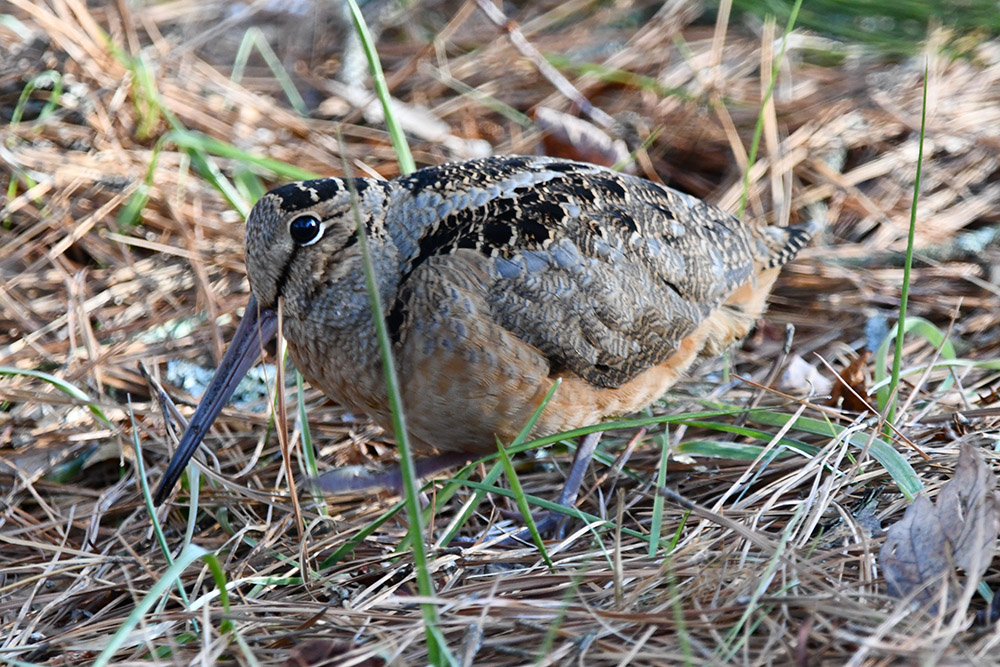
An American Woodcock among the pine straw - Photo by Shirley McNutt
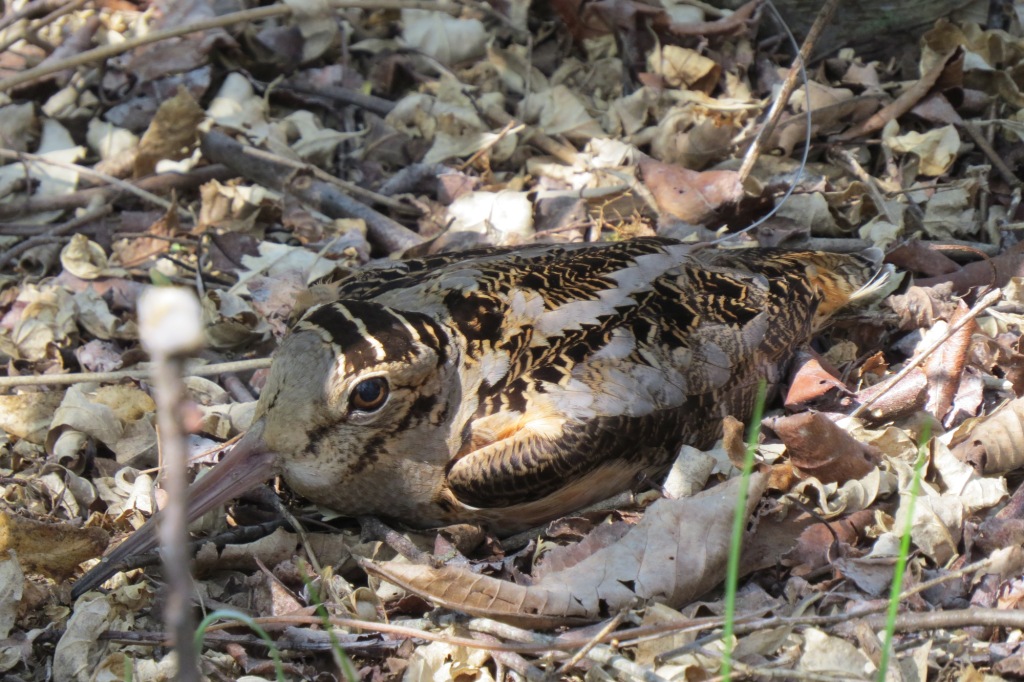
An American Woodcock lays compressed against the ground.
Fact File
Scientific Name: Scolopax minor
Classification: Bird, Order Charadriiformes, Family Scolopacidae
Conservation Status:
- Species of Greatest Conservation Need-Tier 1a on the Virginia Wildlife Action Plan
Size: 9 to 12 inches long with 16 to19-inch wingspan (similar in size to an American Robin)
Identifying Characteristics
Their mottled brown-and-gray coloring makes an excellent camouflage for this forest floor-dwelling, small bird, blending in with the brown grasses and woody debris. Their head and back are a combination of gray and brown, with black bar on the crown of the head, while their lighter underparts are a buff to orange color. The American woodcock has a plump, squat profile with shorter legs, a nearly indiscernible neck, short tail, and a long, pointed bill. Oddly enough, while this bird lives in the forests, it’s part of the shorebird family Scolopacidae.

An American Woodcock perched on the edge of a gravel road. Photo by Keith Ramos/USFWS
The large eyes of American woodcocks are positioned high and near the back of their skull, allowing them to keep watch for danger in the sky while they’re searching the soil for food.
Nicknames for this charismatic bird include timberdoodle, Labrador twister, night partridge, and bog sucker.
Distribution
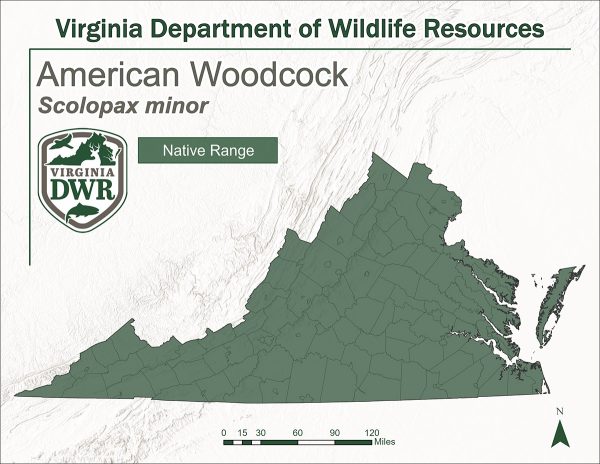
Much of the Virginia population of American woodcock are year-round residents, while the populations on the far western edge of the state tend to breed in Virginia and migrate south to winter. Woodcock populations breeding in northern U.S states migrate to Gulf states to winter.
Behavior
American woodcock spend the majority of their time on the ground in fields and forests, probing into the ground for earthworms. The tip of their bill has a concentration of nerve endings that help woodcock detect their prey in the soil and a flexible upper mandible that helps them capture and extract them. They feed mainly at dawn and dusk.

An American Woodcock hides among the tall field grasses during daylight hours. Photo by Keith Ramos/USFWS
Woodcock are remarkable for their distinctive walk, as they tend to rock their body forward and backward while in motion and foraging, leaving their head still. When flushed, they fly for short distances on short, rounded wings that create a whistling sound.
During mating season, the male woodcock stakes claim on a singing territory in a clearing or open field, where he makes a unique “peent” sound similar to an insect buzzing. Males also perform a striking display flight, where when trying to attract females, he flies up in a spiral to a few hundred feet above the ground, while the air moving through their wings creates a twittering sound. He then descends rapidly in a zig-zag or spiral pattern. Outside of mating and nesting season, woodcock tend to be solitary.
Habitat
American woodcock live in young, second-growth forests, shrubby fields, and mixed forest/agricultural areas. They feed in locations with dense cover and moist soil. Nesting females tend to be found in young to middle-aged forests.

An American Woodcock at home within the forest leaf litter. Photo by Amy Shelton
Diet
The high fat and protein content of earthworms make them the primary choice of prey for woodcock, but they will also seek out other invertebrates like flies, grasshoppers, beetles, crickets, millipedes, centipedes, and spiders. They can consume up to 90 percent of their body weight in 24 hours.
Breeding

DWR Staff fitting a leg band on an American Woodcock hatchling.
Woodcock breed in early spring as males begin their courtship displays of peents and flights at dawn and dusk. Males can mate with multiple females. Females make a shallow depression in exposed ground, usually in a young forest, and lays a clutch of one to five eggs. The female can be quick to abandon a nest if disturbed during early days of incubation, but as the eggs get closer to hatching, she will attempt to distract predators with broken-wing displays.
After an incubation period of 20 to 22 days, gray hatchlings with splotches of brown and gray emerge. They learn to forage on their own after three or four days. At a month old, they become independent.
Conservation
Because of land use changes over time, ideal habitat for the American woodcock declined, leading to the species being included as a Species of Greatest Conservation Need in the Virginia Wildlife Action Plan. Goals for habitat improvement include more diverse forest management that prioritizes early to mid-successional forest stages suitable for woodcock breeding and foraging.
DWR recently participated in a large-scale study of woodcock ecology along with 27 other wildlife organizations from the U.S. and Canada. The University of Maine coordinated the Eastern Woodcock Migration Research Cooperative, which gathered data on migration patterns, harvest rates (percentage of the population that is taken by hunters), survival, and reproduction by capturing woodcocks and attaching small GPS transmitters to them.

A DWR staff member holding an adult woodcock before placing a GPS transmitter on it.
A recent project on the Mattaponi Wildlife Management Area (WMA) managed habitat for both woodcock and quail. A combination of prescribed burning, timber harvesting, bush-hogging, and mulching helped to create a dense, shrubby habitat border on edges of logging roads that benefits woodcock, quail, turkeys, and songbirds. Plantings of partridge pea, beggar’s lice, and bush clover will help attract insects for foraging. DWR partnered with U.S. Fish and Wildlife Service, the National Wild Turkey Federation, the Ruffed Grouse Society/American Woodcock Society, the Wildlife Management Institute, and the Northeast Association of Fish and Wildlife Agencies for the project.
Additional Information
Want to get in the weeds with the American Woodcock? Visit the American Woodcock species account located within the Second Edition of the Virginia Breeding Bird Atlas.
Here you will find more information regarding the breeding distribution, breeding trends, timing of breeding, and conservation efforts involving the American Woodcock, as well as other birds that breed in Virginia.
Last updated: October 13, 2026
The Virginia Department of Wildlife Resources Species Profile Database serves as a repository of information for Virginia’s fish and wildlife species. The database is managed and curated by the Wildlife Information and Environmental Services (WIES) program. Species profile data, distribution information, and photography is generated by the Virginia Department of Wildlife Resources, State and Federal agencies, Collection Permittees, and other trusted partners. This product is not suitable for legal, engineering, or surveying use. The Virginia Department of Wildlife Resources does not accept responsibility for any missing data, inaccuracies, or other errors which may exist. In accordance with the terms of service for this product, you agree to this disclaimer.