
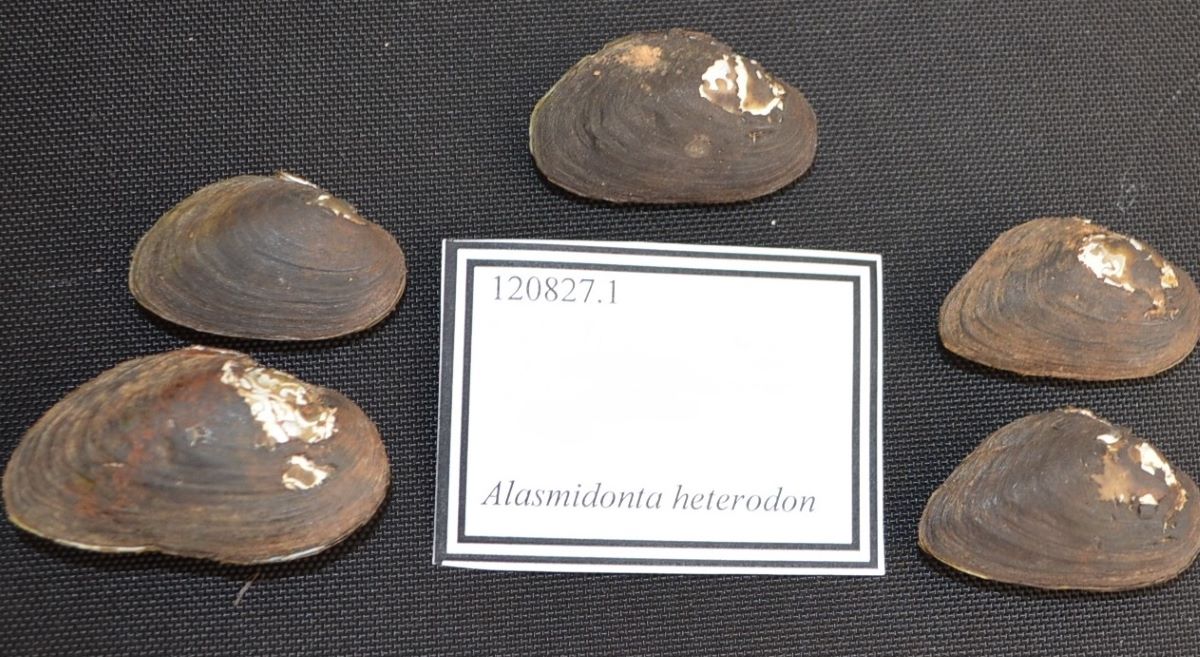
Shells of the Dwarf Wedgemussel. Photo by ©John Alderman
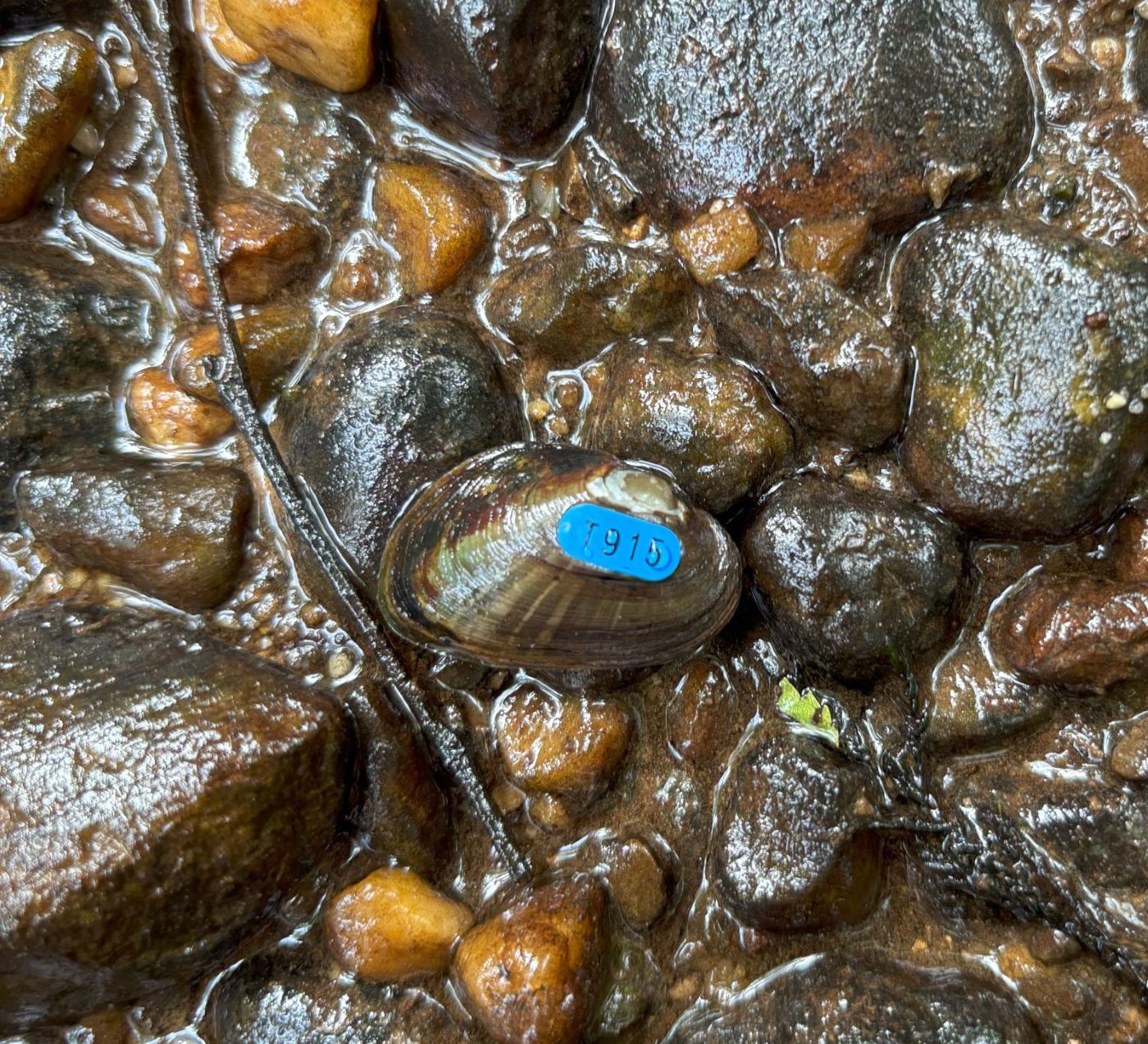
A Dwarf Wedgemussel affixed with a Hallprint Tag for monitoring purposes. Photo by ©Kayla Howard - DWR
Fact File
Scientific Name: Prolasmidonta heterodon
Classification: Freshwater Mussel, Family Unionidae
Conservation Status:
- Federally Endangered in the U.S.
- State Endangered in Virginia
- Species of Greatest Conservation Need-Tier 1a on the Virginia Wildlife Action Plan
Size: Dwarf Wedgemussel can reach up to 56 mm in length
Life Span: Dwarf Wedgemussel can live up to 12 years
Distribution
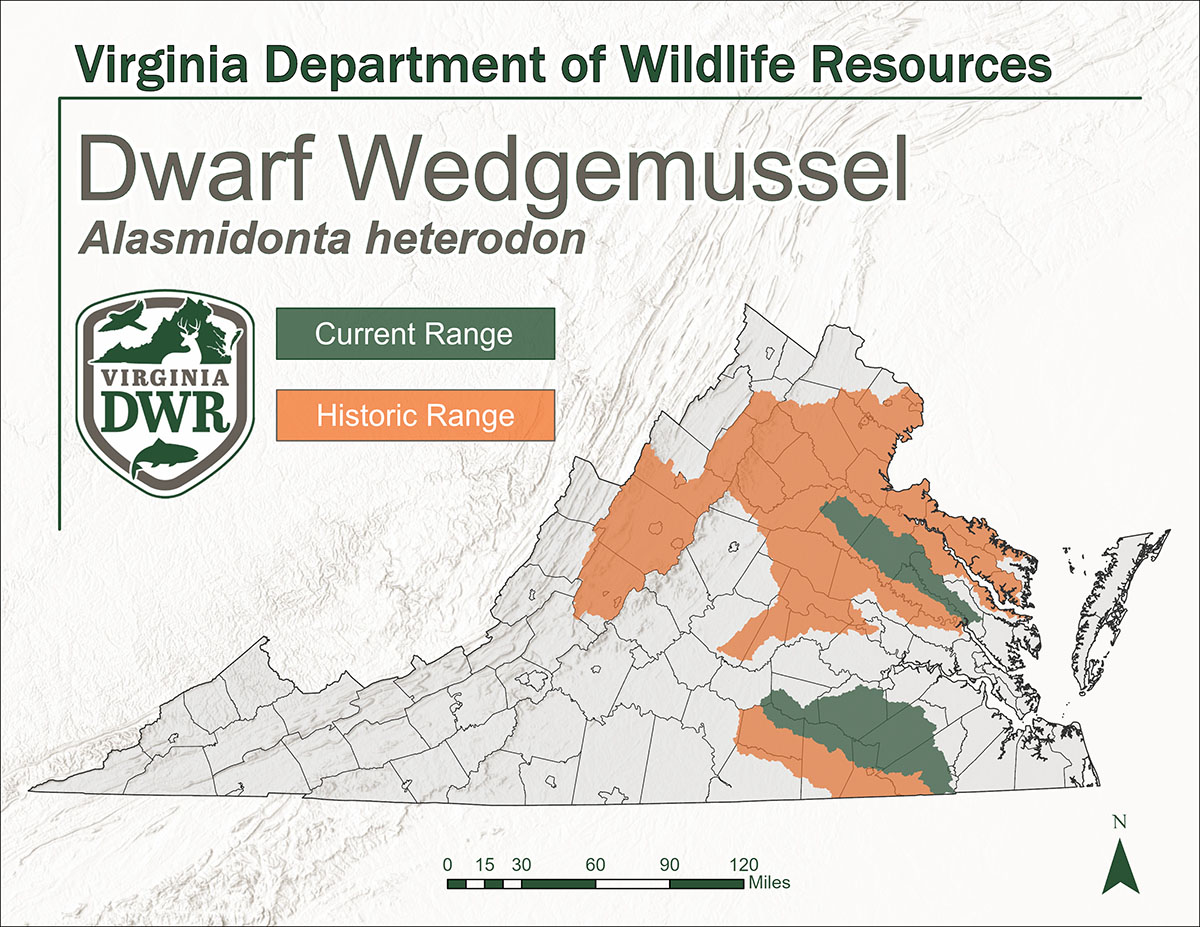
The Dwarf Wedgemussel historically occurred throughout much of the Atlantic Slope drainage in Virginia, with populations present in the Chowan, James, Potomac, Rappahannock, and York River basins. Populations are now reduced to the Chowan and York River basins, although it is likely that the only viable population remaining occurs in the York River basin.
Identifying Characteristics
- Small, thin, inflated shell
- The anterior end is sharply curved, and the posterior end is pointed near the base and truncated above
- The ventral margin may be broadly curved or straight
- The outer covering of the shell (periostracum) varies from yellowish-olive brown, green, to black in color
- Faint reddish-brown rays of variable width may be present
- The inner portion of the shell (nacre) is bluish-white
Habitat
The Dwarf Wedgemussel inhabits streams and rivers of various sizes and flow regimes, with a substrate composition of mud, sand, and gravel, with little silt deposition.
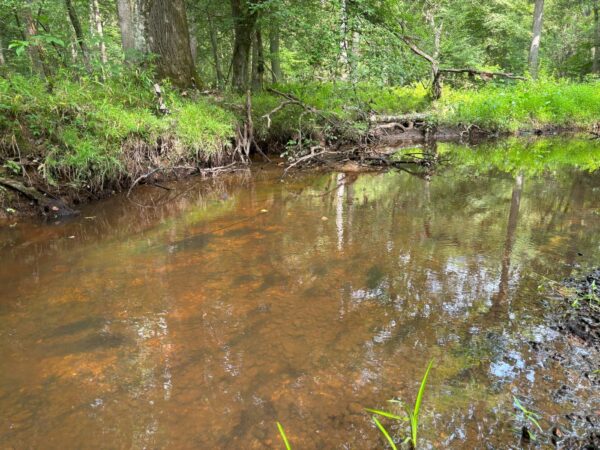
Typical habitat where Dwarf Wedgemussel may be encountered. Photo by ©Kayla Howard – DWR
Life History
Freshwater mussels have a very unique life cycle. Parasitic larvae, called glochidia, develop in the gills of the female mussel. Once mature, the glochidia are expelled from the gills of the mussel and must attach to the gills of a suitable host fish, where they complete their transformation into a juvenile mussel. They then detach from the fish and begin their free-living existence on the river bottom.
Some freshwater mussels are host-specialists, meaning that metamorphosis can only occur on a limited number of closely related fish species, while others are host-generalists, with the ability to complete their life cycle using many different species. Female mussels employ a variety of strategies that “trick” their host fish into becoming “infested” with their glochidia. Some have elaborate mantle displays that protrude out of the shell that a fish attacks, while others release their glochidia in packets called “conglutinates” that resemble prey items that fish will ingest.
The Dwarf Wedgemussel relies on multiple benthic-dwelling species for successful transformation: Fantail Darter (Etheostoma flabellare), Johnny Darter (Etheostoma nigrum), Tessellated Darter (Etheostoma olmstedi), Mottled Sculpin (Cottus bairdii), and Slimy Sculpin (Cottus cognatus). It is currently unknown how female Dwarf Wedgemussel infest their host fish.
Conservation
The Dwarf Wedgemussel was listed as federally endangered in 1990, due to widespread declines throughout its range. The species appears relatively stable in the northernmost portion of its range, while populations in the south are declining. Surveys throughout Virginia to detect Dwarf Wedgemussel also show declines, with likely only one viable population remaining. Actions such as targeted surveys, propagation, and augmentation are needed in order to prevent the extirpation of Dwarf Wedgemussel from Virginia.
Special Considerations
Freshwater mussels are extremely imperiled organisms. DWR regulates the take and possession of freshwater mussels occurring within the state. It is unlawful to take mussels from any inland waters in the Commonwealth except as provided for in §§ 29.1-418 and 29.1-568 of the Code of Virginia. Additionally, the Dwarf Wedgemussel is listed as an endangered species under federal and Virginia law. It is a violation of both federal and state law to harass, harm, or take the Dwarf Wedgemussel in Virginia.
For more information, see Virginia’s Endangered Species Act.
Last updated: February 11, 2026
The Virginia Department of Wildlife Resources Species Profile Database serves as a repository of information for Virginia’s fish and wildlife species. The database is managed and curated by the Wildlife Information and Environmental Services (WIES) program. Species profile data, distribution information, and photography is generated by the Virginia Department of Wildlife Resources, State and Federal agencies, Collection Permittees, and other trusted partners. This product is not suitable for legal, engineering, or surveying use. The Virginia Department of Wildlife Resources does not accept responsibility for any missing data, inaccuracies, or other errors which may exist. In accordance with the terms of service for this product, you agree to this disclaimer.