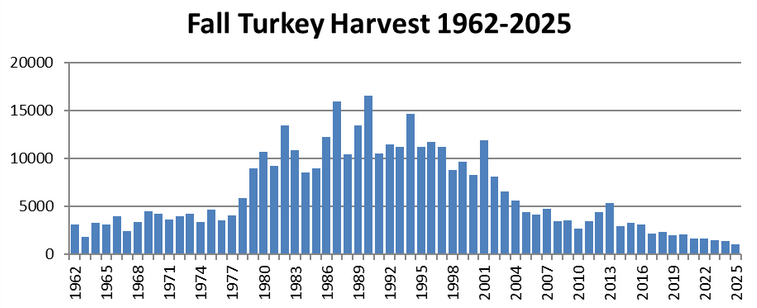

A total of 1,022 wild turkeys were harvested in Virginia during the 2025–26 fall turkey hunting season, well below the 2024–25 season total of 1,423. This represents a 28% decline from the 2024-25 season and 38% below the previous 5-year average (2020 through 2024–25 seasons).
The decline in fall turkey harvest noted over the past several seasons can likely be attributed most to declining hunter participation. DWR hunter survey data indicates that fall turkey hunter numbers have declined by approximately 64% since 2005 and that many turkey hunters are choosing to either hunt other species in the fall or are saving turkey tags for the more popular spring turkey season.
Besides hunting participation, another important driver of fall hunting success is the annual reproductive success. In 2025, the productivity estimate (1.3 poults/hen) was far below the long-term average (2.6 poults/hen) and the lowest since the survey began in 2007. Decreased productivity was evident in all regions of the state, except for southwestern Virginia, where observed poult productivity was near the long-term average, thanks in part to a periodic cicada hatch in the coalfield counties. Since juvenile birds can account for 40-60% of the fall harvest, reproductive success greatly influences turkey populations available for fall harvest.
The harvest declines from the previous season seemed to be most apparent during the October firearms segment (38%) and the Thanksgiving segment (33%), which has historically been the most heavily utilized portion of the fall turkey hunting season. The largest decreases came from changes in hen harvest, which declined approximately 42%. Adult gobbler harvest was also down approximately 20%, while juvenile male harvest was almost identical to the previous season.
While all regions experienced a decrease in harvest, southwest Virginia observed the least significant decline (8%), which is likely due to improved reproduction in that region during the summer of 2025. In general, counties east of the Blue Ridge experienced greater declines in harvest than those west of the Blue Ridge. The majority of the harvest (94%) occurred on privately owned land.
Fall turkey hunting remains one of Virginia’s most unique hunting opportunities, and as such, potential strategies that might enhance participation moving forward were included during revision of the Virginia Turkey Management Plan, endorsed by the Board of Wildlife Resources during the May 2025 meeting.
County-by-County Fall Turkey Harvest Data (2025–2026)
Fall Turkey Harvest Data by County: Five-Year Trends
Virginia Fall Wild Turkey Harvest Data
| Season/Method | Number Harvested | % Total Harvest | |
|---|---|---|---|
| Total Harvest | 1,022 | 100 | |
| Type of Turkey | |||
| Without Beard | 422 | 41.3 | |
| Beard <7” | 209 | 20.5 | |
| Beard >7” | 391 | 38.3 | |
| Region | |||
| East of Blue Ridge | 498 | 48.7 | |
| West of Blue Ridge | 524 | 51.3 | |
| Land Type | |||
| Private | 958 | 93.7 | |
| Federal | 41 | 4.0 | |
| State | 23 | 2.3 | |
| Time Frame | |||
| Archery | 228 | 22.3 | |
| Youth/Apprentice | 14 | 1.4 | |
| First Two Weeks | 114 | 11.2 | |
| Wed. & Thanksgiving | 269 | 26.3 | |
| December | 323 | 31.6 | |
| January | 73 | 7.1 | |
| Weapon | |||
| Rifle | 418 | 40.9 | |
| Shotgun | 339 | 33.2 | |
| Muzzleloader | 25 | 2.4 | |
| Bow | 88 | 8.6 | |
| Crossbow | 150 | 14.7 | |
| Pistol | 2 | 0.2 | |
| Region | |||
| 1 (Tidewater) | 189 | 18.5 | |
| 2 (South Piedmont) | 200 | 19.6 | |
| 3 (SW Mtn) | 347 | 34.0 | |
| 4 (NW Mtn) | 177 | 17.3 | |
| 109 | 10.7 | ||