
Have you seen a wild turkey lately? We want to know about it…
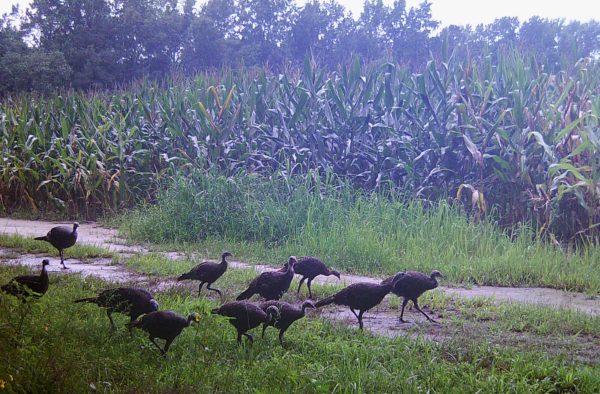
Courtesy Joshua Hanson
The Virginia Department of Wildlife Resources (DWR) wants your help with our annual Turkey Summer Sighting Survey, which runs from July through August. This survey, otherwise known as the brood survey, has been ongoing in Virginia since the early 2000s and is one of our best indicators of annual turkey reproduction. DWR employees have been running this survey annually, but we’re looking to increase the amount of area surveyed. By incorporating observations from the public, we can expand our understanding of statewide turkey populations.
If you see wild turkeys between July 1 and August 31, please report your observation to us. You can either upload a photo, and we’ll determine the age and sex of the turkeys for you, or you can submit the number of hens, poults (juvenile turkey), and gobblers you observed, along with the location of the sighting using our brief survey form. No matter which option you pick, every observation helps us better understand Virginia’s turkey population!
How to Participate
Thank you for your interest in the Turkey Summer Sighting Survey! The Survey is open annually from July through August, so please check back next year for more information on how to participate.
How to Age and Sex Wild Turkeys
- Wild Turkey Summer Sighting Survey Guide: Sexing and Aging of Wild Turkeys
- Learn More About Wild Turkey in Virginia
Frequently Asked Questions
Can I submit a photo and the survey for the same observation?
No, we don’t want to count the same observation twice. Please submit either a photo of your observation or complete the survey.
Should I avoid duplicate submissions of what I think are the same birds?
If you suspect you’ve already submitted the same birds via one of the options, please don’t submit them again. This will help us minimize counting the same bird multiple times.
What will you do with the collected information?
The information collected through the survey is used to help understand population status and assists in making recommendations for hunting seasons and other management actions. The past data has also been used by multiple research institutions to gain better understanding of factors that may influence turkey population growth or declines. These data are also being used at the regional and national scale to assess general turkey population trends and status.
What other information do you collect on turkey populations?
DWR monitors turkey populations in multiple ways. Because we cannot physically count all of the turkeys in the state, we use surveys or harvest data to develop an index of the population. This enables us to look at changes in the index over time to identify trends (increasing, decreasing, or stable). One of the primary tools we use to do this is the harvest monitoring system. This allows us to look at both long- and short-term trends in turkey harvests as an index of the population. Utilizing harvest data in this way, we can identify long-term trends or changes at county and regional scales. Other data sources such as the Bowhunter Survey and the Spring Gobbler Survey enable hunters to provide data for what they are seeing on the ground, which can also be analyzed for changes in trends over time. These surveys allow us to further organize observations by effort so we have a better understanding of how hunting behaviors and patterns may influence overall harvest or observation patterns. New and emerging technologies such as eBird are providing new and innovative ways for monitoring and will be further incorporated as the tools develop.
Who should I contact if I have more questions about the Turkey Summer Sighting Survey?
Email Mike Dye, Forest Gamebird Biologist, at mike.dye@dwr.virginia.gov.