

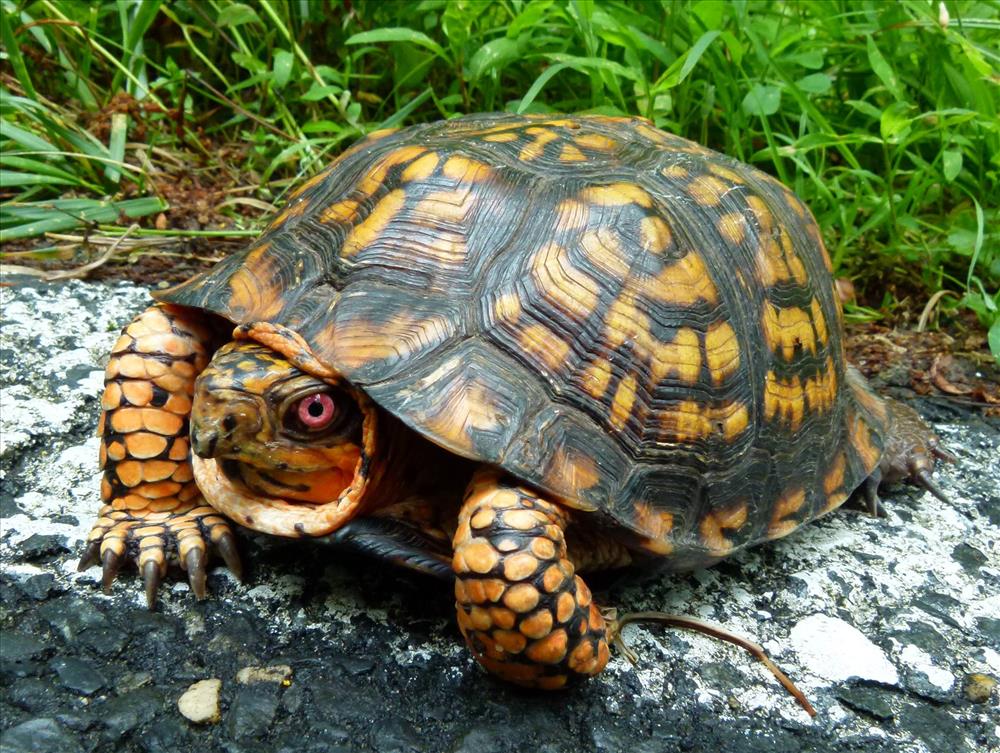
Woodland Box Turtle. ©Photo by U.S. National Park Service
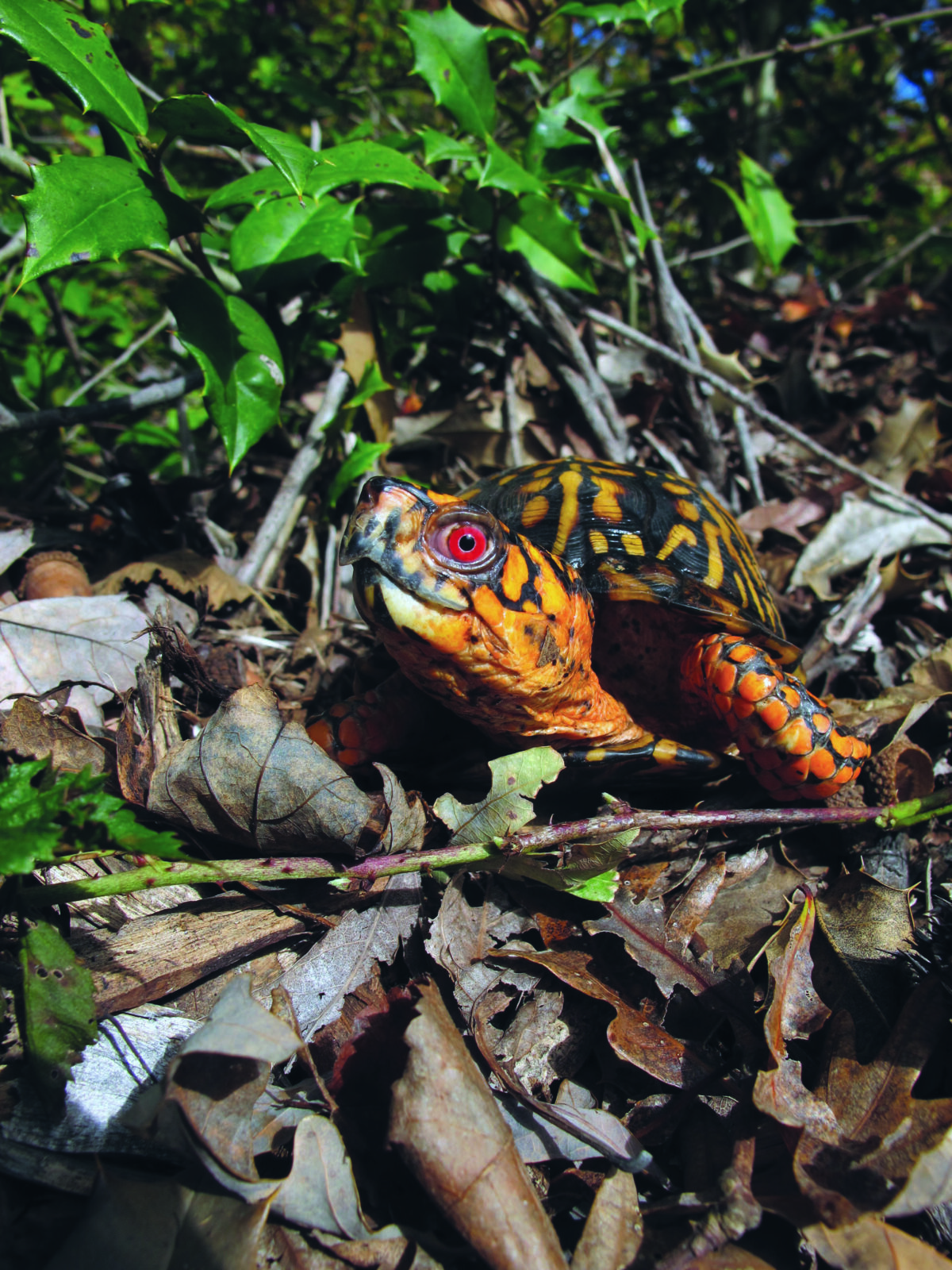
Male box turtles will occasionally have bright red eyes, but this is not a defining sexual characteristic. ©Photo by J.D. Kleopfer
Fact File
Scientific Name: Terrapene carolina carolina
Classification: Reptilia, Order Testudines, Family Emydidae
Size: 4.5 - 8 inches
Life Span: On average 25-35 years, but can live more than 100 years in captivity
Distribution
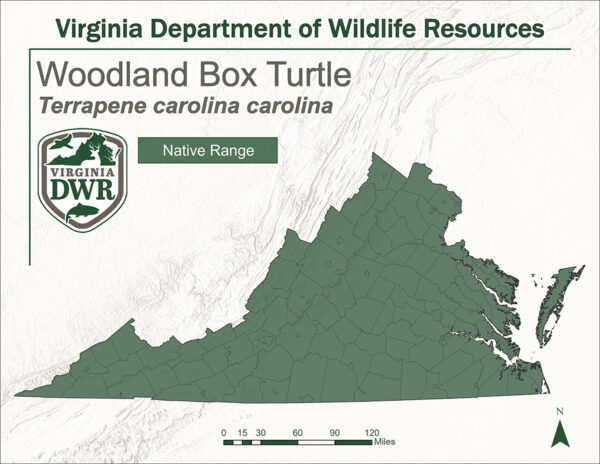
The Woodland Box Turtle is native throughout Virginia.
Identifying Characteristics
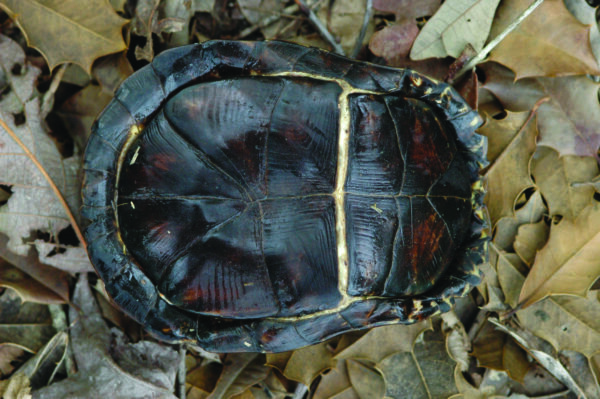
Box turtle shell with hinged plate indicative of their name. ©Photo by J.D. Kleopfer – DWR
- The Woodland Box Turtle is a medium-sized terrestrial turtle that reaches a maximum length of about 8 inches.
- The shell is highly domed, elongate, and smooth on the rear edge. The rear edge may be flared in some adults.
- The color is brown, or sometimes black, with orange to yellow spots, blotches or lines, the pattern of which varies greatly.
- The underside (plastron) may be brown or black and may have an irregular pattern of cream or yellow.
- The skin of the head, neck, and legs is brown with orange to yellow spots, streaks, or blotches.
- Adult Woodland Box Turtles may have a sharply defined beak on the upper jaw.
- The Woodland Box Turtle’s name originates from its hinged plastron that enable it to completely withdraw into and close its shell.
- The Woodland Box Turtle is seldom confused with other Virginia species, with the exception of the Wood Turtle Glyptemys insculpta, which lacks the high-domed shell and the hinged plastron. The Wood Turtle is also much less common in Virginia.
Habitat
The Woodland Box Turtle occupies a variety of wooded habitats in Virginia, such as hardwood forests, mixed oak-pine forests, pine flatwoods, maritime oak forests, hardwood swamps, and edge habitat near agricultural areas.
The Woodland Box Turtle will readily use water, but only temporarily. This is typically associated with summer aestivation, drinking, or for ease of migrating. During prolonged periods of hot and dry weather, the Woodland Box Turtle will hide in pools of water, mud, or even damp ground in the shade.
Behavior
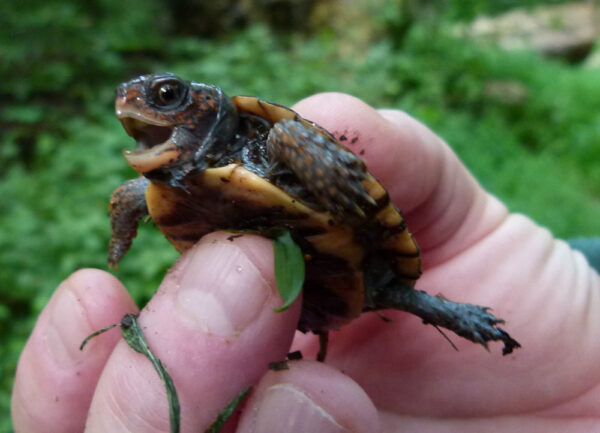
A young Woodland Box Turtle. ©Photo by Alicia Lafever – U.S. National Park Service.
The Woodland Box Turtle requires 10 to 20 years to reach sexual maturity and have a relatively low reproductive rate, laying just 2 to 7 eggs per year. Nesting activity typically occurs between late May and late July.
During winter, the Woodland Box Turtle will burrow several centimeters in the soil beneath leaf litter and grass clumps. Woodland Box Turtles emerge from brumation in early spring and remain active until late fall. Nesting activity generally occurs from late May through July with 2-7 eggs deposited in a nest. Brumation requires mature forests.
Diet
The Woodland Box Turtle is an opportunistic omnivore and will consume a variety of fruiting plants, mushrooms, slugs, earthworms, salamanders, and even carrion.
Conservation
- The Woodland Box Turtle is illegal to possess in Virginia.
- Woodland Box Turtle populations are estimated to have declined 32% over the last 100 years
- One of the top threats to the Woodland Box Turtle is due to the thousands that are illegally caught for the pet trade from the wild each year
- Habitat fragmentation and urbanization have contributed to the decline of Woodland Box Turtle numbers throughout their range
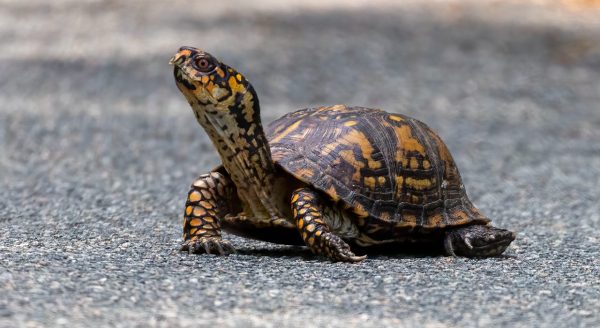
Woodland Box Turtles are often observed along roadways as they attempt to cross in search of suitable habitat.
Did You Know?
Box turtle shells have readily been observed at archeological sites in Virginia. Shells were used for food containers, hand rattles, and trade.
Sources
- Myers, P., R. Espinosa, C. S. Parr, T. Jones, G. S. Hammond, and T. A. Dewey. 2023. The Animal Diversity Web (online). Accessed at https://animaldiversity.org.
- U.S. National Park Service. Alicia Lafever. Juvenile Eastern Box Turtle. https://npgallery.nps.gov/AssetDetail/D6E68312-1DD8-B71C-07A2AD941DC30161
- U.S. National Park Service. Eastern box turtle (Tarrapene carolina carolina), Catoctin Mountain Park, 2014. https://npgallery.nps.gov/AssetDetail/0a258fe1b424491d801040deba0cdb13
Last updated: June 18, 2026
The Virginia Department of Wildlife Resources Species Profile Database serves as a repository of information for Virginia’s fish and wildlife species. The database is managed and curated by the Wildlife Information and Environmental Services (WIES) program. Species profile data, distribution information, and photography is generated by the Virginia Department of Wildlife Resources, State and Federal agencies, Collection Permittees, and other trusted partners. This product is not suitable for legal, engineering, or surveying use. The Virginia Department of Wildlife Resources does not accept responsibility for any missing data, inaccuracies, or other errors which may exist. In accordance with the terms of service for this product, you agree to this disclaimer.